Parenting with ADHD means I will never be the calm, perfectly consistent mother I once pictured I’d be. For a long time that felt like proof I was failing my child. Then I learned the piece of science that quietly set me free: no parent is that mother — and it isn’t perfection that raises a secure kid in the first place. It’s repair.
I’m a nurse with ADHD and a mom, so I know both versions of this — the clinical one on the chart, and the 6 p.m. one where the noise is too much, my patience is spent, and I hear my own voice come out sharper than I meant it to. Today I want to make the case that parenting with ADHD doesn’t have to be a project of becoming someone I’m not. It can be about getting very, very good at the one thing that actually builds a child: coming back after I’ve gotten it wrong.
How does ADHD show up in my parenting?
Two ways, mostly — and neither is the one people picture when they hear “ADHD parent.”
The first is the missed signal. My attention runs where it wants, not always where it’s needed, so I can miss the small, quiet cues: the slightly-too-quiet “I’m fine,” the face that falls for half a second before smoothing over. It isn’t that I don’t care. My bandwidth is just already full, and the subtle stuff slips past before I catch it. This is the empathy-dysregulation side of ADHD that nobody warns you about: not a cold heart, just a crowded one.
The second is the volume. My emotions don’t arrive at a polite conversational level; the dial jumps from zero to a hundred with nothing in between. That’s textbook ADHD emotional dysregulation, and I’ve written about living with that volume dial in my post on ADHD emotional dysregulation. In parenting, the dial is the whole difference between calmly saying “please put your shoes on” and snapping it — over shoes, of all things.
Is my ADHD damaging my kids?
This is the question that used to keep me awake. If I miss cues and I run loud, am I quietly wiring my child for the same anxiety I carry?
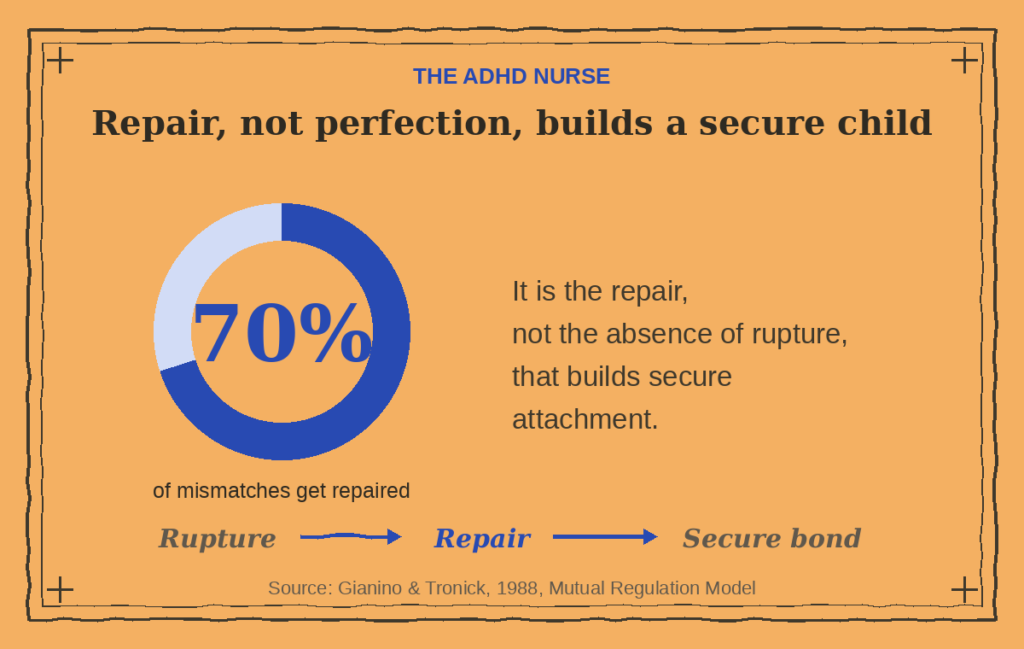
The honest answer, from the research, turned out to be a relief. What shapes a child is not a parent who never gets it wrong. Even the most attuned parent and baby spend much of their time slightly out of sync — and in one foundational study of mother-infant pairs, those mismatches were repaired about 70 percent of the time in the very next moment. It is that repair, not the absence of rupture, that builds secure attachment (Gianino & Tronick, 1988).
Read that again if you’re an ADHD parent, because it changes the whole job. The rupture isn’t the failure. The rupture is normal; every parent alive is out of step with their kid a good chunk of the day. The repair is the parenting. And repair happens to be something I can get good at, even with a brain that misses cues and runs hot.
What does repair actually look like?
Repair is simpler and harder than it sounds. It’s going back. “I snapped at you earlier. That wasn’t about you — I got overwhelmed, and I’m sorry. I love you.” Short, specific, no grand speech.
But before I can say that honestly, I have to do something first: accept my own situation clearly, without flinching. I can’t repair what I won’t admit. When I can look at my own ADHD plainly — this is a brain that runs loud, this is why I snapped — then I can name it to my child accurately, too. And that accuracy is the actual gift. It tells him the storm was mine, not something he caused, so he doesn’t quietly file the moment away as “something is wrong with me.” That honest self-seeing is the whole reason I wrote about ADHD self-acceptance: it turns out it isn’t only good for me — it’s the thing that lets me keep my child from carrying my weather as his own fault.
This is exactly what the therapist Hilary Jacobs Hendel, writing about Edward Tronick’s research, means when she says the pressure to be a flawless parent misses the point entirely (Hilary Jacobs Hendel, “Rupture and Repair,” Psychology Today, January 16, 2020).
“Misattunement happens to all parents. Being perfectly attuned just isn’t possible — nor would it be a good thing, anyway. What builds emotional security is a parent’s determination to repair ruptures soon after they have occurred.” — Hilary Jacobs Hendel, LCSW, 2020
How can I keep parenting with ADHD — imperfectly?
I stopped trying to fix my brain and started building around it. A few things that actually hold:
Externalize the load. I don’t trust my head to run a household — it leaks. So the routines, the reminders, the visual schedule on the fridge do the remembering for me. It’s the same trick I lean on for my own working memory and for time blindness: get it out of my mind and into the physical world, so I’m not white-knuckling every transition from memory. Fewer surprises means fewer moments where the volume dial spikes.
Medication, on the days it’s on board. I’m a nurse; I’ll say it plainly. On the days I’ve taken mine, the dial is easier to hold. I’m responding to my child instead of reacting to him, and that alone prevents a lot of ruptures before they start.
Set a time aside to reset . For me, that’s daily prayer. This is where I set things down. Each day I try to keep a time set apart to think about my misses before God — the snap, the cue I walked right past — and to repent and apologize for what I’ve done wrong, and not to drag yesterday’s failure into today as fresh guilt. Having that time is how I close the rupture with myself, so I can start the next morning clean instead of ashamed. An ADHD brain will happily replay every mistake on a loop; a set-apart daily slot is where I take it off the loop.
So no — I’m not a perfect ADHD parent, and I’ve finally stopped auditioning for the role. I miss cues. I run loud. And then I go back, I own it, I reconnect. It took me years to believe that perfection was never the assignment. Repair was. And repair, thank God, is something even a loud, leaky, distractible mother can do beautifully.
Are you parenting with ADHD too? What does repair look like in your house — the words you use, the way you come back? Tell me in the comments.
This is my personal experience and general information, not medical advice. If ADHD is making it hard to parent the way you want to — with your patience, your consistency, or your mood — a clinician can help you build real supports around it. You’re not a bad parent; you may just be under-resourced.

Grace is a registered nurse with thirteen years of clinical experience — five in Australia and eight in Korea — who also lives with ADHD. She writes The ADHD Nurse: honest, first-person guides and diaries about working, parenting, and getting through the day with an ADHD brain. Everything here is her personal experience and general information, not medical advice.