ADHD self-acceptance is something I’ve never quite said out loud — so I’ll say it here, where it’s safe to be unfinished.
My daydreaming runs high. High enough that I finally wrote a whole post about maladaptive daydreaming. And if I’m honest about what that much daydreaming usually means, I have to admit the thing sitting underneath it, too: I carry an inferiority complex, and my self-esteem has always run low.
That is not a fun sentence to type. But here’s what I’ve learned, and it’s the whole point of this entry: admitting the unflattering truth isn’t weakness — it’s the first act of self-acceptance, and the only thing that ever lets me see myself clearly.
Is admitting I’m ordinary a brag — or ADHD self-acceptance?
It isn’t a brag — but choosing to say it out loud is its own quiet act of ADHD self-acceptance. “I feel less-than and I don’t think much of myself” is nobody’s highlight reel.
And yet here’s the stubborn little thought I keep circling back to: maybe saying it out loud — naming the unflattering thing instead of hiding it — is its own quiet kind of brave. Not a flex about being impressive. A flex about being honest.
Because the more I look around, the less alone it feels. Almost everyone I know is carrying some version of this — a private inferiority, a self-esteem that wobbles on a bad day. Which makes me… ordinary. Just another person with the same soft spots as everybody else. I’m not uniquely broken. This is the human default.
And there’s a reason this particular soft spot runs so deep for me. A systematic review found a robust link between ADHD and low self-esteem in adults (Pedersen et al., 2024, Journal of Attention Disorders) — and it makes a sad kind of sense. When you grow up missing deadlines, forgetting things, hearing you’re not trying hard enough on repeat, the shortfall quietly compounds into a story about your worth. So the inferiority I’m confessing isn’t a separate defect stacked on top of the ADHD. For a lot of us, it is part of the package. And weirdly, learning that made it lighter — a shared wound is easier to set down than a private one.
There’s a line I keep coming back to from a message on our church’s channel (around the 15:00 mark): admitting that you’re ordinary is, paradoxically, the extraordinary thing. When I first heard it, something in my chest unclenched. The bravery was never in pretending to be special. It was in being willing to be plain — and to say so.
Why do I have to accept myself before I can see clearly?
Because acceptance has to come first — admitting it does one quiet thing before anything else: it means I’ve accepted myself, the real me, not the edited one.
And acceptance, it turns out, is the only thing that ever lets me see myself clearly. As long as I’m busy hiding the inferiority, I can’t actually look at it — I’m too busy keeping it out of frame. But the moment I say it plainly, it stops being a shameful secret and becomes something much more useful: information. Just data about how I’m built. The same shift I went through with my late ADHD diagnosis — shame turning into something I can actually work with.
There’s research underneath this part, too. When psychologists look at what actually protects the mental health of adults with ADHD, the strongest factor isn’t high self-esteem — it’s self-compassion: treating yourself like someone you’re on the side of. One 2022 study of more than 500 adults with ADHD found that low self-compassion, above almost anything else, tracked with worse mental health (Beaton et al., 2022, Journal of Clinical Psychology). That lines up exactly with what I’m fumbling toward here. The goal was never to talk myself up into feeling special. It’s to look at the plain, ordinary me without flinching — and then be gentle with her anyway. That shift — from quietly despising myself to quietly siding with myself — is the whole engine under this entry, and the part I most want you to try, too.
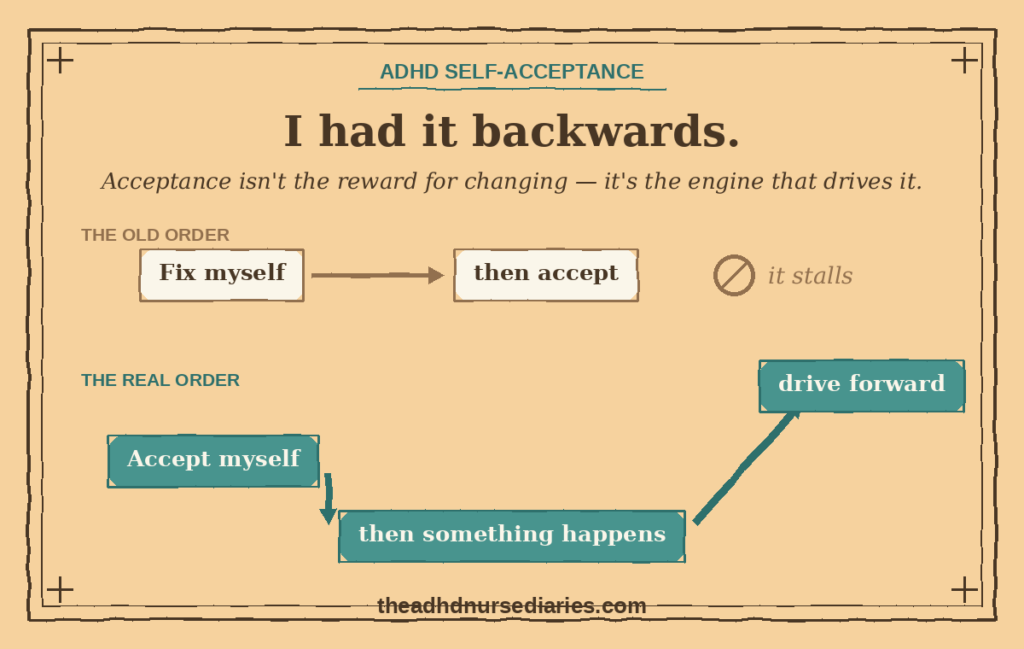
Carl Rogers put it perfectly: “The curious paradox is that when I accept myself just as I am, then I can change” (Carl Rogers, On Becoming a Person, 1961). For most of my life I had it backwards — I thought I had to fix myself before I was allowed to accept myself. It’s the other way around. Acceptance comes first. The clear-eyed view of myself comes second. And only then can I take the next step.
“The curious paradox is that when I accept myself just as I am, then I can change.”
— Carl Rogers, On Becoming a Person (1961)
So where does this leave me?
Not at a finish line — at a starting line I can finally see. So no, this entry isn’t a win I’m showing off. It’s me setting the heavier version of myself down on the table where I can finally see her — ordinary, a little insecure, prone to disappearing into daydreams, and, for the first time, oddly okay with saying so.
That’s not the finish line. It’s the first honest step. But it’s the first one I’ve taken while actually looking at where my feet are — and for once, I know which way it points.
And the next step, I think, is smaller and kinder than the old one. Not fix her, then maybe like her, but be on her side while she figures it out. That’s the self-compassion the research keeps pointing at — and the first time it’s ever sounded possible to me. I’m not there yet. But for once I’m at least facing the right way.
Is there an unflattering thing about yourself you’ve quietly come to accept — and did saying it out loud change how you saw it? I’d really love to hear, in the comments. This is one of those safe places to be unfinished.
This is my personal experience, not medical advice. If low self-esteem or shame are weighing on you, you don’t have to carry them alone — an ADHD-informed clinician or counselor can genuinely help.

Grace is a registered nurse with thirteen years of clinical experience — five in Australia and eight in Korea — who also lives with ADHD. She writes The ADHD Nurse: honest, first-person guides and diaries about working, parenting, and getting through the day with an ADHD brain. Everything here is her personal experience and general information, not medical advice.