ADHD time blindness is, hands down, the hardest part of living inside my brain. Not the messiest, not the loudest — the hardest. It’s the one that quietly wrecks everything else: the appointments, the deadlines, the plans I genuinely meant to keep.
I am late. I’m late the way some people are left-handed — it’s just how I’m built. I look up and an hour has vanished. I’m sure I have “plenty of time,” and then suddenly I don’t, and I never once saw the gap close.
The clearest example runs like clockwork, which is almost funny for someone with no sense of clocks. Every other week I miss the church bus. Not because I leave late, exactly — because I still have time right up until I suddenly don’t. So I flag down a taxi and pay more than ten times the bus fare to get there. It isn’t a rare slip-up. It’s basically a line in my budget.
ADHD time blindness: why is time so hard for me?
Because my brain really only registers two times: now, and not now.
Time blindness isn’t an official diagnosis — it’s a term coined by Dr. Russell Barkley, who describes ADHD as, at its core, trouble regulating yourself across time (Sarah Greenberg, “ADHD and ‘Time Blindness,'” Understood, June 15, 2023). To my brain, “now” is enormous and right in my face, and “not now” — tomorrow, Friday, the deadline two weeks out — is tiny and far away, almost unreal. So I don’t truly feel the deadline until it has already turned into now. By then, of course, it’s too late.
And this isn’t just my impression. A meta-analysis of 26 studies — more than 2,300 people — found that people with ADHD consistently misjudge how much time has passed (Marx et al., 2022, Journal of the American Academy of Child and Adolescent Psychiatry). It’s a real, measurable difference, not a character flaw I can scold myself out of.
And it’s tangled up with everything else about ADHD. My attention won’t regulate itself, so I lose whole evenings to hyperfocus. My dopamine-starved brain wants the reward sitting right in front of me, not the one waiting somewhere off in a blurry future. My executive function — the part that’s supposed to plan, sequence, and start things on time — is running on fumes. Add emotion to the pile and a looming task feels so overwhelming that I avoid it, which only makes me later.
Here’s the part I find almost funny: poor time management is caused by all of this — and then it loops back around and becomes its own problem, feeding the stress, the avoidance, the shame. Cause and consequence, chasing each other in a circle.
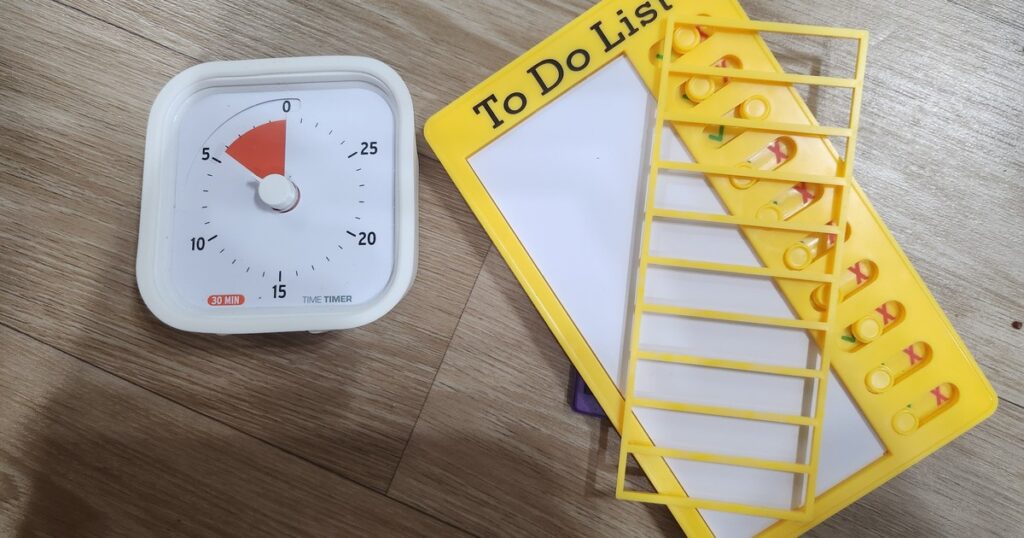
ADHD time blindness: I have the tools — so why don’t I use them?
Honestly? Because for an ADHD brain, knowing the fix and doing the fix are two completely different things. Dr. Russell Barkley sums up the whole trap: “ADHD is not a disorder of knowing what to do; it is a disorder of doing what you know” (Russell A. Barkley, Taking Charge of Adult ADHD, 2010).
“ADHD is not a disorder of knowing what to do; it is a disorder of doing what you know.”
— Russell A. Barkley, PhD
I own a Pomodoro timer. It sits there. I know about time blocking. I know you’re supposed to break big goals into small steps. I can recite all of it — and I have almost never actually done any of it. Reading the advice gives me a little hit of “look at me, working on myself,” and then I close the tab and carry on exactly as before.
The clearest proof is the business I just started. A sensible person would have researched it, made a plan, mapped out the categories and the numbers first. Me? I just… dove in. No system, no structure, no analysis — headfirst, the way I do everything. It’s thrilling for about a week. Then the missing plan starts quietly sending me the bill.
ADHD time blindness: what actually makes me act on time?
Externalizing time — getting it out of my head and into somewhere I can’t avoid seeing it. Dr. Russell Barkley calls this the real fix for ADHD: don’t store time inside, where it vanishes; put it outside, where it’s loud and in the way.
There’s one corner of my life where I actually do this, and it’s the one where mistakes cost money — my resale business. Anything I send to the forwarding warehouse has to be logged the second it happens, because if I wait even a little, it’s gone from my mind for good. So even when I can’t be bothered, I do it right then. And two alarms run my day: one at 11:30 to message my customers, one at 3:00 for the order cut-off. When the alarm sounds, I do the task. The alarm holds the time so my brain doesn’t have to — and honestly, building that kind of routine might be the most ADHD-friendly thing I’ve done for myself.
I haven’t cracked the rest yet. Giving myself a real reward for finishing, or blocking tasks into my calendar — I know they help people, but I just haven’t tried them. And every external trick has a ceiling when I’m the only one enforcing it. Which brings me to the part I kept avoiding. Willpower was never the missing piece. A person beside me was.
So what am I finally trying?
I’m admitting the thing I really don’t like admitting: I can’t do this alone.
Every time I’ve tried to fix my time by myself — just me, my unused timer, and a fresh burst of determination — it has fallen apart within days. So I’m done betting on solo willpower. What actually steadies my brain is having someone there: working alongside other people, even silently (it has a name — body doubling), so that “later” finally has a witness and a shape.
That’s why I finally stopped just reading about it and signed up. I joined ADDA — the Attention Deficit Disorder Association — starting with their Beginner Club, a weekly meeting for people new to all of this. For me it lands on Friday mornings, Korea time (Thursday for the US members). The membership runs about $9.99 a month, and it comes with the one thing I can’t hand myself: a room full of adults who get it. Time management is one of the most common struggles adults with ADHD report (ADDA Editorial Team, “ADHD Time Blindness: How to Detect It & Regain Control Over Time,” ADDA, March 20, 2025) — so I’ll be in good, and very understanding, company.
Then I did the part that actually scares me. I registered for a body-doubling work group called Productivity PowerHour+ (Body Doubling, Pomodoro-Style). Everyone gets on a call, names a goal out loud, and then we work quietly side by side in 25-minute Pomodoro sprints, checking in between rounds. It’s the someone in the room my brain needs — except the room is a screen, and it turns out that’s enough.
I’ll report back on how it really goes — the good, the awkward, all of it — in a future entry. But for the first time, I’m not white-knuckling my way toward being on time. I signed up to stop doing it alone.
Are you time-blind too? What’s the one tool you actually use — or the one you keep ignoring on your desk, like me? Tell me in the comments.
This is my personal experience, not medical advice. “Time blindness” is a widely used term, not a formal diagnosis. If time and deadlines are wearing down your work, your money, or your relationships, an ADHD-informed clinician can genuinely help — and so, it turns out, can other people.

Grace is a registered nurse with thirteen years of clinical experience — five in Australia and eight in Korea — who also lives with ADHD. She writes The ADHD Nurse: honest, first-person guides and diaries about working, parenting, and getting through the day with an ADHD brain. Everything here is her personal experience and general information, not medical advice.