ADHD impulsive spending, for me, looks like this: last week a home-shopping channel got me twice in one sitting. Two boxes, back to back. Probiotics and skin cream — a year’s supply of each. Did I need them? Sort of. Did I need twelve months of them, today, delivered in bulk? I did not. And here is the part that stings to type: I don’t currently have a job.
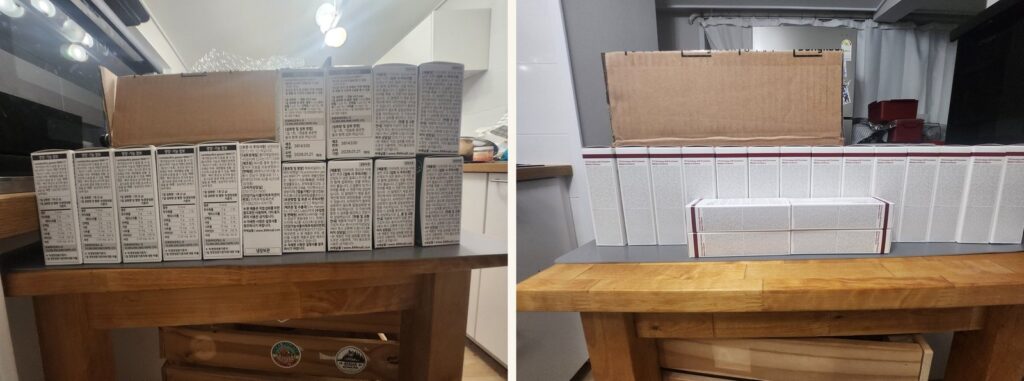
This is exactly the season of my life when I should be guarding every won (₩ — the Korean currency). I know that. I knew it while my finger was pressing the order button. So why does knowing never seem to be enough? For me, this is what ADHD impulsive spending looks like — and I’m starting to understand it isn’t simply a lack of willpower.
ADHD impulsive spending: why can’t I stick to a savings plan?
Because for an ADHD brain the start is easy and the long middle is where it quietly falls apart. Here’s the strange thing: I’m not someone who refuses to plan. I plan constantly. I have opened savings accounts. I have a pension plan. I once started a household ledger with genuine enthusiasm.
And yet — I have never, not once, carried a savings account all the way to maturity. The ledger? I’ve never kept one longer than a week. The pattern is always the same: a bright, organized beginning, and then somewhere in the long flat middle, the money quietly leaves and the notebook quietly closes.
If you’re reading this with an ADHD brain of your own, let me ask: how many savings accounts have you actually carried to the finish line? I have a feeling I’m not the only one with a graveyard of well-intentioned bank products.
ADHD impulsive spending: is it real, or just bad willpower?
It’s real — and it isn’t simple weak willpower. For a long time I called this a character problem — no patience, no discipline. But that’s not quite what’s happening.
My prefrontal cortex was never aiming for the finish line in the first place. ADHD compromises exactly the functions that long-term money management leans on: planning, problem-solving, follow-through. I’ve written before about how this shows up at work and at home — but it doesn’t stop at the office door or the laundry pile. It walks straight into your bank account.
And there’s a second piece, one that finally made my spending make sense to me: researchers call it delay discounting (the tendency to choose a smaller reward now over a bigger one late). To my brain, a reward twelve months away isn’t just smaller — it’s blurry, almost fictional. “Future me with savings” feels like a stranger in someone else’s story, while “today me with a year’s supply of probiotics” is vivid, urgent, and one click away. It was never that I lacked patience. It’s that later barely exists on my map.
ADHD impulsive spending is common and costly: a Monzo survey with YouGov found that 60% of people with ADHD say it directly hurts their finances, costing an estimated £1,600 a year in unplanned spending — and 58% blame impulsive buys (Monzo, “Living with ADHD Can Cost an Extra £1,600 a Year Because of Difficulties Managing Your Money,” 2025).
As Cambridge ADHD specialist Professor Barbara Sahakian explains, everyday money tasks are hard because “things may drop out of working memory as something more interesting captures their attention” (University of Cambridge, “The Hidden Cost of ADHD: How Attention Challenges Impact Financial Wellbeing,” 2025).
The driver is the same dopamine loop behind the rest of this blog — a new purchase delivers an instant hit that an under-stimulated brain is wired to chase, while executive dysfunction makes the long-term cost hard to weigh in the moment. Naming it as a brain-based pattern, not a character flaw, is what makes the friction tricks worth setting up.
“Things may drop out of working memory as something more interesting captures their attention.”
— Professor Barbara Sahakian, University of Cambridge
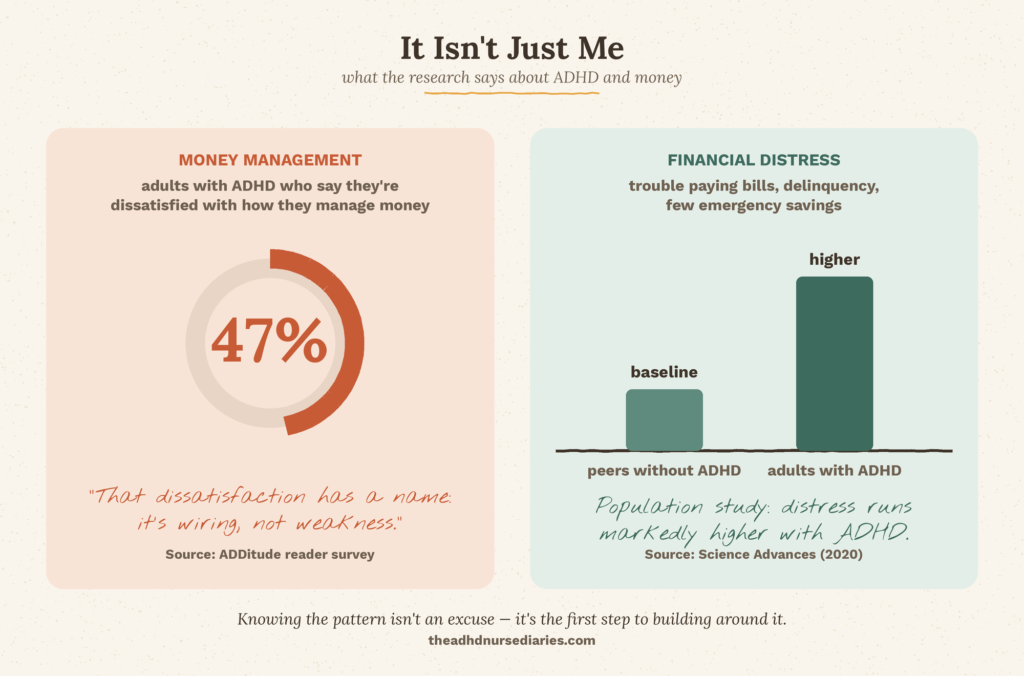
I’m not alone in this, either. Studies comparing adults with and without ADHD keep finding the same picture: more impulsive buying, less saving, and a higher reliance on spontaneous, in-the-moment money decisions (Bangma et al., 2020, PLOS ONE). At the harder end, a population study found adults with ADHD face markedly higher rates of financial distress — trouble paying bills, more delinquency, fewer emergency savings (Beauchaine et al., 2020, Science Advances). And in an ADDitude survey, 47% of adults with ADHD said they’re dissatisfied with how they manage money (ADDitude Editors, “16 Ways to Better Manage Your Money with ADHD,” ADDitude, May 7, 2025).
ADHD impulsive spending: how do I finally outsmart it? (6 friction tricks)
Willpower has lost this fight too many times to count. So I stopped fighting with willpower and started building friction instead — little obstacles placed exactly where my impulses like to run.
Here’s my current system. None of it is sophisticated. All of it works better than promising myself I’ll “be careful”:
- One-month goals, not one-year goals. A savings product I can actually finish in a month gives my brain a real finish line — close enough to see, close enough to want.
- Savings in a bank I never use, plus auto-transfer. If canceling requires an app I haven’t logged into for months and a password I barely remember, that’s friction working in my favor.
- Spare money scattered, not pooled. One big visible balance is an invitation. Several small ones are boring.
- One credit card. Exactly one. With the lowest limit they would give me. And no store-affiliated shopping cards, ever — their discounts are bait. Dodge a small annual fee today, and by December you’ve spent millions of won more.
- Cash advance limit: zero won. Set it once, and the 3 a.m. version of me can’t undo it before morning.
- No installment plans, ever. If I can’t pay for it whole, my brain treats it as free. It is not free.
Notice the theme: none of these require me to be a better person tomorrow. They only required one good decision on one good day — and now that decision stands guard so I don’t have to.
The probiotics, in case you’re wondering, are lined up on my shelf like a small army. I’ve decided to let them stay. They’re a year’s worth of breakfast-time reminders: this is the brain I manage, and the management is going better than it used to.
Now it’s your turn — what tricks actually work for you? The weirder and more specific, the better. Share your friction in the comments, and let’s build a toolbox together.
This is my personal experience and general information — not medical or financial advice. If impulsive spending is causing you real hardship, an ADHD-informed clinician (and a fee-free financial counselor) can genuinely help.

Grace is a registered nurse with thirteen years of clinical experience — five in Australia and eight in Korea — who also lives with ADHD. She writes The ADHD Nurse: honest, first-person guides and diaries about working, parenting, and getting through the day with an ADHD brain. Everything here is her personal experience and general information, not medical advice.