ADHD impulsivity gets a bad rap — and honestly, some of it is earned. But it’s also the reason that, while more careful people are still weighing the risks, I’ve already started. I run an online resale business, and my brain doesn’t do “let me think it over for a week.” It does “think it, do it.” Today I want to make the case for the side of ADHD impulsivity that nobody puts on a symptom checklist: the one that turned a scary idea into a running business.
I’m a nurse with ADHD, so I know exactly how this trait reads in a chart — poor impulse control, acting without weighing consequences. But lived from the inside, on a good day, it feels less like a deficit and more like a launch button.
What is ADHD impulsivity — and why does it feel like a superpower?
ADHD impulsivity is acting on an idea before the “should I?” committee in your head has finished meeting. A neurotypical brain tends to run the long loop: think → analyze → weigh the risks → maybe, eventually, act. My ADHD brain skips most of the middle and warps straight from “think” to “go.”
That’s the same wiring behind the un-glamorous stuff — interrupting, impulse buys, blurting. But it’s also a low latency to action: a bias for doing over deliberating. And when an opportunity is time-sensitive, the person who acts on Tuesday beats the person still researching it on Friday. It’s not that I’m braver than careful people. It’s that fear of failure never gets a chance to catch up with my curiosity — I’ve usually already tried the thing before the fear arrives. (It’s the same trait that can make ADHD a real superpower when the conditions line up.)
Is ADHD impulsivity actually good for business?
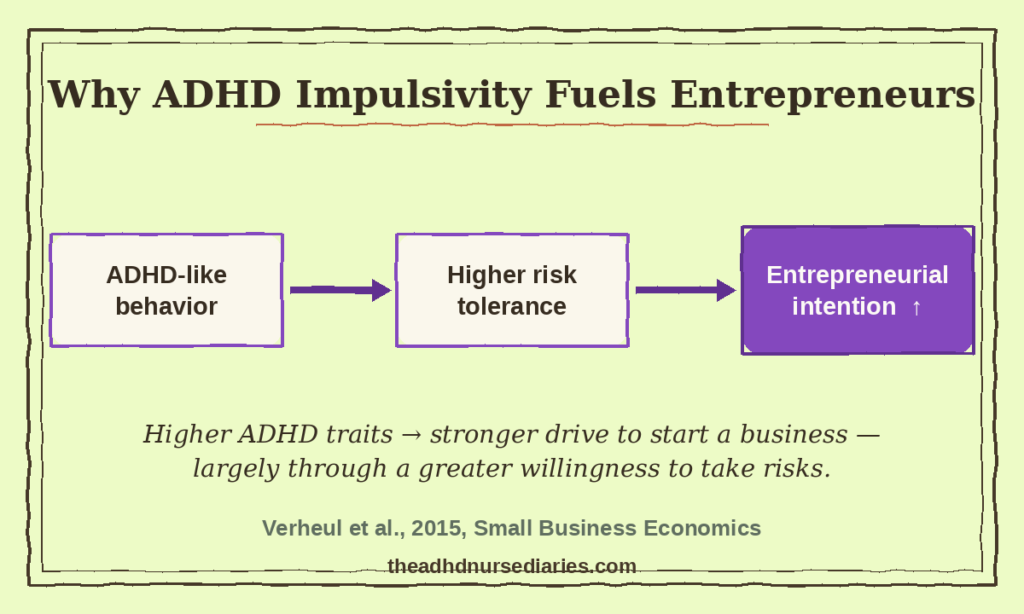
Yes — and the research backs it up more than you’d expect. Study after study has linked ADHD traits to entrepreneurship: people with higher levels of ADHD-like behavior report stronger entrepreneurial intentions, and a big part of that link runs straight through a higher tolerance for risk (Verheul et al., 2015, Small Business Economics). Researchers have even pinpointed that it’s the impulsive and hyperactive side of ADHD — not the inattentive side — that’s most tied to entrepreneurial action (Wiklund et al., 2017, Journal of Business Venturing).
Johan Wiklund, the Syracuse University professor who leads much of this research (and has ADHD himself), says it better than I can — while everyone else waits for certainty, we just move (Linda Roggli, “Entrepreneurship and ADHD: Fast Brain, Fast Company?,” ADDitude, August 20, 2025).
“Those with ADHD tend to spur themselves into action regardless of uncertainty. An impulsive inability to wait comes with a willingness to take risks.”
— Johan Wiklund, Ph.D.
For me, that’s not theory. Starting a resale business “properly” would have meant months of market research I’d never have finished. Instead I opened one shop, listed a handful of products, and learned by doing — which, it turns out, is the only way my brain actually learns.
Why do I catch trends before everyone else?
Because a brain that runs on novelty is always scanning for the new thing — and then acting on it before it’s obvious. Co-working with an AI is a perfect example: I started running my whole blog workflow with an AI partner before most people around me had seriously tried one. I jumped in first and figured it out by doing — the same story I tell in my post on co-working with an AI.
Interest and newness are rocket fuel for the ADHD brain — the same interest-based wiring I dug into in my job-hopping story. A trend most people notice and “keep an eye on,” I’ve usually already jumped on.
Sometimes that’s a flop, and I eat the loss. But every so often, moving first means I’ve claimed a rising item before the market catches up — and in resale, being early is most of the game. My impulsivity isn’t patient enough to wait for permission, and in a fast market, impatience is an edge.
What’s the shadow side of ADHD impulsivity?
Let me be honest, because a nurse who only sells you the upside isn’t being a good nurse. The exact same launch button that starts businesses also starts things I shouldn’t — purchases I regret, projects I abandon at 70%. The research says the same thing: ADHD traits in entrepreneurship are complex and can lead to positive and negative outcomes. “Act first, think later” builds momentum — and, left unmanaged, it also builds clutter and debt.
I’ve written about the money version of this in my post on ADHD impulsive spending — the probiotic army, the skincare battalion, all bought on the same instant “yes.” The drive is real. So is the wreckage when I don’t put rails on it. Owning both halves is the whole point.
How do I harness ADHD impulsivity without getting hurt?
I stopped trying to switch it off — you can’t — and started building guardrails around it instead. Three that actually hold for me:
1. Aim the impulse at ideas; add a checkpoint before money. I let myself act instantly on anything free — the second I spot a product idea, I’ll draft the listing and message a supplier that night. But anything that costs real money gets one rule: sleep on it 24 hours. For example: if a “must-stock” item would mean buying $300 of inventory, it goes into a note until tomorrow — and nine times out of ten, the can’t-miss idea has quietly cooled by morning. The idea still gets my speed; my bank account gets a beat.
2. Externalize the “finish.” My brain loves starting and hates the boring last 30%. So the moment I begin something, I write the final steps down as a checklist. For example: when I open a new product listing, I immediately jot down “1) photos, 2) description, 3) price, 4) publish.” Then when my interest fizzles halfway, I’m looking at two concrete steps left — not a vague, un-startable “finish the listing.” A written step is far easier to return to than one I’m juggling in my head.
3. Let “first” be a strategy, not an accident. I know I move early, so I lean into it on purpose instead of apologizing for it. For example: rather than waiting until I’m “sure” a trend will sell, I list a single unit the day I notice it. If it moves, I reorder; if it doesn’t, I’ve lost almost nothing. Being early becomes the plan — not luck, and not something to feel bad about later.
That’s the reframe. ADHD impulsivity isn’t a character flaw I have to keep apologizing for. It’s a fast, risk-tolerant, first-mover engine — and my job isn’t to shut it off. It’s to point it somewhere good and put the brakes exactly where they belong.
Are you an “act first, think later” brain too? Has your impulsivity ever launched something that careful planning never would have? Tell me in the comments.
This is my personal experience and general information, not medical advice. ADHD impulsivity carries real risks too — if it’s hurting your finances, relationships, or safety, a clinician can help you build supports around it.

Grace is a registered nurse with thirteen years of clinical experience — five in Australia and eight in Korea — who also lives with ADHD. She writes The ADHD Nurse: honest, first-person guides and diaries about working, parenting, and getting through the day with an ADHD brain. Everything here is her personal experience and general information, not medical advice.