Is ADHD a superpower?
Here’s my honest answer as a nurse who has it: not a superpower in the comic-book sense, but not just a disorder either. ADHD is a different kind of wiring that becomes a real strength under the right conditions — and a real struggle under the wrong ones.
Under the right conditions, that wiring gives me focus, speed, and a knack for reinvention. Under the wrong ones, it’s why my kitchen counter vanishes under a pile of “I’ll deal with it later.” Both are true at once. So let’s look at what the science actually says — and where my own life fits.
Is ADHD a superpower, really?
Not in the comic-book sense — but research on successful adults with ADHD keeps finding real, repeatable strengths. In one study, researchers interviewed high-functioning adults with ADHD and grouped what they heard into six themes: dynamism, courage, energy, humanity, resilience, and transcendence — with divergent thinking and hyperfocus coming up again and again (Sedgwick et al., 2019, ADHD Attention Deficit and Hyperactivity Disorders).
The catch lives in the phrase “under the right conditions.” These strengths show up when interest, environment, and support line up — not on command, and not while you’re white-knuckling a boring form at 4 p.m.
What is hyperfocus, and is it real?
Yes, it’s real. Hyperfocus is the ability to lock onto something interesting so completely that hours disappear. A 2019 study with the perfect title — “Living in the zone” — found that adults with ADHD experience hyperfocus more often than people without it, across schoolwork, hobbies, screen time, and the real world (Hupfeld et al., 2019, ADHD Attention Deficit and Hyperactivity Disorders).
I know it from the inside. When a topic grabs me, I study it with an intensity that pulls other people in — back in school, younger classmates used to gather around me and ask to borrow my notes. Michael Phelps, diagnosed with ADHD at nine, aimed that same locked-in focus at a swimming pool and walked away with 23 Olympic gold medals (The Understood Team, “Celebrity spotlight: How Michael Phelps’ ADHD helped him make Olympic history,”Understood). The trick is never summoning hyperfocus on demand. It’s pointing it at something that matters.
Why are so many entrepreneurs wired this way?
Because the ADHD brain chases novelty and acts fast — which is more or less the job description for starting things. A large study of nearly 10,000 people found a positive link between clinical ADHD and both the intention to start a business and actually doing it (Verheul et al., 2018, Small Business Economics).
Richard Branson, who built the Virgin empire after leaving school early, has been open about both ADHD and dyslexia, and credits his wiring for helping him “see the big picture where others don’t and to view challenges as opportunities” (Richard Branson, “How Dyslexia Made Me a Better Businessman,” Time, October 30, 2015).
“It has helped me to think creatively, to see the big picture where others don’t, and to view challenges as opportunities.”
— Richard Branson (2015)
I’m no billionaire, but I recognize the pattern. I’ve worked more than ten different jobs — I actually counted recently, and it was well past ten — and instead of scattering me, all of it melted into something useful. It’s why I can write this blog, and why at church I can understand people from almost any walk of life.
If ADHD is a strength, why does it hurt so much?
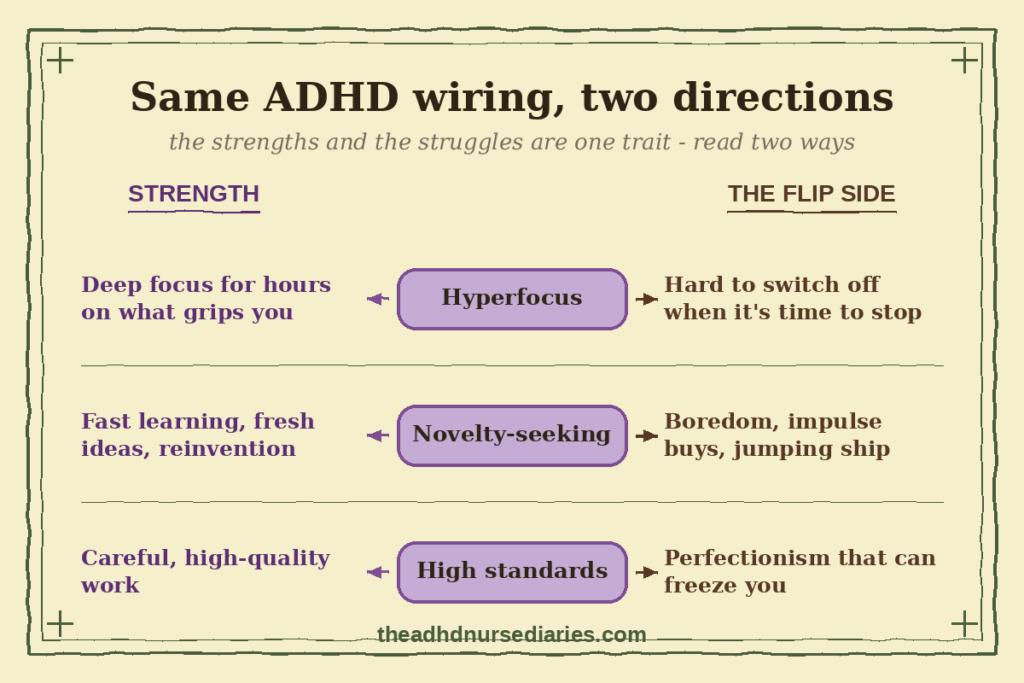
Because the same wiring that powers hyperfocus also powers the freeze. I won’t pretend otherwise — calling ADHD a pure superpower is its own kind of lie, the toxic-positivity kind that leaves you feeling broken when you can’t just “use your gift.” The drive that helps me pick up new tools fast is the same drive that stalls on boring tasks (that’s ADHD task paralysis), and the high standards that sharpen my work are the same ones behind my perfectionism.
The strengths and the struggles aren’t two separate lists. They’re the same trait, read in two directions.
When gymnast Simone Biles’ confidential medical records were leaked in 2016, she didn’t hide. She wrote, “Having ADHD, and taking medicine for it is nothing to be ashamed of nothing that I’m afraid to let people know” (Simone Biles, X, September 13, 2016). That mix — real strength alongside zero shame about needing support — is exactly the balance I’m after.
How do I turn ADHD into a strength?
You stop trying to fix the brain and start designing conditions where it shines. For me, a few things turn the dial:
- Follow the interest. My curiosity is wide on purpose, and it has made me a broader person — every job and hobby left a skill behind. I pick up new tools faster than almost anyone around me; these days I’m the person in my circle, regardless of age or job, who knows AI best and actually uses it every day. I built videos and websites quickly because the novelty pulled me in.
- Aim the focus. The same intensity that once made classmates borrow my notes now goes into writing and into learning what’s coming next. I tend to feel where the world is heading a beat before the people around me do.
- Borrow support without shame. will.i.am of the Black Eyed Peas manages his ADHD not with medication but with music: “When I write music, I make order out of disorder” (will.i.am, quoted in “Will.i.am: One of Many Celebrities with ADHD,” ADDitude, June 9, 2021). Whatever your version of that is — a co-writer, a timer, an AI working alongside you — use it.
There’s a quieter strength in all of this, too: it keeps me young. The constant curiosity, the appetite for the next new thing, the antenna for what’s changing — they keep me moving forward instead of settling, and honestly, they make life feel young.
So, is ADHD a superpower? Not the way the memes promise. But it isn’t only a disorder either. It’s a high-variance brain — capable of remarkable focus, speed, and reinvention when the conditions are right, and genuinely hard when they’re not. The goal isn’t to brag about the strengths or hide the struggles. It’s to build a life that gives the good wiring somewhere to go.
What’s one ADHD trait that’s actually worked in your favor? Tell me in the comments — I’d love to hear where your wiring takes you.
This is my personal experience, not medical advice. If ADHD is affecting your daily life, an ADHD-informed clinician can help.
Grace is a registered nurse with thirteen years of clinical experience — five in Australia and eight in Korea — who also lives with ADHD. She writes The ADHD Nurse: honest, first-person guides and diaries about working, parenting, and getting through the day with an ADHD brain. Everything here is her personal experience and general information, not medical advice.