I’m an ADHD perfectionist — a contradiction I’ve finally made peace with: I want everything to be perfect, and that is exactly why so little of it gets done. If you want proof, come and look at my house.
For years I read my messy home as laziness. It isn’t. It’s the wreckage of a quiet war between perfect and unfinished — and I am both sides of it. The imperfect woman who aches for things to be perfect. That dissonance isn’t a flaw in me. That’s me — an ADHD perfectionist.
Here’s a small, slightly embarrassing example from this very week. For my last post, I wanted a photo of a clock reading 3 a.m. My own clock wouldn’t cooperate — so, instead of just grabbing any picture like a reasonable person, I went down a rabbit hole hunting for the perfect 3 a.m. image. I lost the better part of an evening to it. That’s the other face of my perfectionism: it doesn’t only freeze me at the start of the things that matter; it can also quietly swallow whole hours on the things that don’t.
If this sounds backwards — an ADHD perfectionist with a messy house — it’s actually a well-documented pattern. In one ADDitude reader survey, 42% of adults with ADHD said they identify with all the major perfectionist traits at once — not feeling “good enough,” all-or-nothing thinking, unreasonable standards, and more (ADDitude Editors, “What Perfectionist Traits Infiltrate Your ADHD Brain?,” ADDitude, May 12, 2025). As clinical psychologist Sharon Saline explains, ADHD perfectionists “are all-or-nothing thinkers; if it’s not completely right, then it must be a failure” (Sharon Saline, Psy.D., ADDitude webinar on perfectionism).
“They are all-or-nothing thinkers; if it’s not completely right, then it must be a failure.”
— Sharon Saline, Psy.D., clinical psychologis
That all-or-nothing logic is exactly the trap: a job feels worth doing only if it’s done flawlessly, so anything short of perfect quietly becomes “later.” Many of us also pick up perfectionism as armor — after years of missed deadlines and criticism, impossibly high standards feel like the only way to stay in control.
ADHD perfectionist: why is starting so hard?
Because what looks like procrastination in an ADHD brain usually isn’t laziness — it’s task paralysis. People assume the hard part of any task is the middle; for me, it’s the very first step, and I finally understand why.
My dopamine — the brain’s “let’s go” chemical — is sitting at zero, while the bar in my head is set at 100. Before I’ve even begun, some part of me already knows it won’t be perfect, and that gap feels unbearable enough that I’d rather not start at all. From the outside it reads as putting things off; on the inside it’s a 100-point standard meeting a 0-point tank — a starter motor that won’t turn over. Perfectionism doesn’t just slow the finish; it jams the very start.
Which means that simply starting — knowing full well it won’t be perfect — is, for me, an enormous act. Far bigger than anyone watching would ever guess.
I feel it most when I think about going back to work. I’m about to start as a new hire doing insurance claims review — a beginner, by definition. And yet I seem to be the only person in the building expecting myself to be flawless on day one. So what rises up isn’t excitement. It’s dread. I don’t want to go. The honest truth is that I’m going because the money ran out — like a calf that got loose for one sweet season, now with a ring through its nose, being led back out to plow the field.
ADHD perfectionist: what if I set the bar at 30 instead of 100?
Here’s what is slowly helping. I stop setting the bar at 100. I set it at 30.
Thirty is low enough that I can actually begin. And here’s the funny part — once I’ve started, I work hard anyway. The effort was never my problem. The starting was. Thirty just gets me through the door.
I’m doing the same thing with the new job, ahead of time. Instead of bracing to be perfect, I’m making “I will make the mistakes a new person makes” the default. Then I’m preparing for that 30-point day so it can’t knock me flat — a few lines and a smile, ready to go: “Ah, so that’s how it’s done. Thank you for telling me — coffee’s on me. I won’t forget it now.” If I expect the stumble, it can’t ambush me.
Can I use my dopamine instead of fighting it?
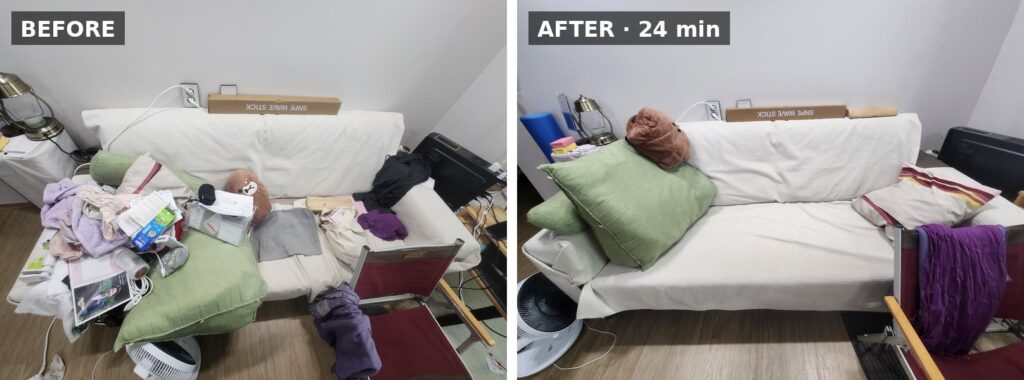
Yes — I stopped making rules and started riding my own dopamine. Cleaning gets the same treatment. Perfection: forbidden. I start in the lowest possible posture — just touch it, just five minutes, just the patch I can reach with both arms out. No grand system. I have set “tidy three times a day, after every meal” more times than I can count, and never once kept it.
So I stopped making rules and started using my own wiring instead. Right now I’m obsessed with this blog — that’s where my dopamine fireworks are going off. So I let them, and then I ride the leftover dopamine: I finish a post, and tidy for five minutes. Find the smallest thing that needs doing, and start there. That’s the whole plan. And honestly? My chest feels lighter than it has in a long time.
That’s how I cleaned the sofa. It took 24 minutes. (Twenty-four whole minutes — and I’m a little proud of every one of them.)
Can a perfectionist admit her imperfect self?
I’m not trying to “fix” my perfectionism, because I don’t think it’s broken so much as turned up far too loud. The imperfect me who longs to be perfect — that contradiction is simply the shape I come in. But I can stop letting the 100 freeze me in place. I can set the bar at 30, ride my own dopami mne, and let “started” count as a win.
My house will never be a showroom. But tonight the sofa is clean, the post is written, and for today, that is more than enough.
Do you freeze at the start because it won’t be perfect? Pick one small thing and set your bar at 30 today — then tell me in the comments what you finally started.
This is my personal experience, not medical advice. If perfectionism or task paralysis is wearing you down, an ADHD-informed clinician can genuinely help — mine did.

Grace is a registered nurse with thirteen years of clinical experience — five in Australia and eight in Korea — who also lives with ADHD. She writes The ADHD Nurse: honest, first-person guides and diaries about working, parenting, and getting through the day with an ADHD brain. Everything here is her personal experience and general information, not medical advice.