Ten dreams, ten bright beginnings
ADHD job hopping leaves a particular residue that nobody warns you about. You’d expect it to be grief — for all the lives you were certain you’d live, and somehow didn’t. For a long time, I assumed that’s what I was carrying too. But when I finally looked closely, it wasn’t the lost careers I mourned. It was something quieter, underneath them. If you have ADHD and your own pile of unfinished dreams, you might know exactly what I mean.
ADHD job hopping: what happened to all my dreams?
Ten of them — ten bright beginnings that each quietly closed. Let me walk you through my résumé of dreams.
As a child, I was going to be a lawyer — mostly because the adults around me lit up whenever I said it. Then adolescence arrived, and I was going to be a dancer, a pop star. I lost that dream somewhere in the long grey years of studying for exams.
By the time I finished university I wanted to be a simultaneous interpreter; I even enrolled in a school for it — until translating into my own mother tongue turned out to be brutally hard, and I let it go. So I turned toward international trade, but I couldn’t find a job.
I loved film, so I talked my way onto a production crew as the lowest assistant director. They didn’t pay me. I left after two months. Then I was going to be a screenwriter — the kind who succeeds so visibly that everyone is forced to notice — until pregnancy and raising my child quietly closed that door too.
Later I taught English. I worked a convenience-store counter. For a few seasons I even taught dance — the pop-star dream, come true sideways. If I counted every field I’ve chased or actually worked in, it would easily reach ten.
Ten dreams. Ten bright beginnings. And a long trail of doors that closed before I made it through – my own kind of ADHD job hopping.

ADHD job hopping: why can’t I stay in a job?
Not because I’m lazy — because ADHD changes the brain’s follow-through system. Nursing is the closest thing I have to a personal best — thirteen years of it, all told.
And yet, since I moved back to Korea, the old pattern followed me home. Seven months at the first job. Eight at the next. The others, two or three years apiece. Five jobs in eight years — and I’m now looking for my sixth. It wasn’t always this way. Back in Australia, I once stayed at the same job for five years.
So it’s not that I can’t commit — it’s that the fit, the stimulation, and the environment have to line up before my ADHD brain will stay. The one small comfort is that each one lasts a little longer than the last. I am, very slowly, setting a new personal record.
And it turns out my pattern isn’t unusual. Adults with ADHD are 60% more likely to be fired and three times more likely to quit a job impulsively — and roughly one in three is out of work at any given time (ADDA Editorial Team, “Impact of ADHD at Work,” ADDA, 2023, citing Barkley, 2008).
For years I told myself a cruel story about all of this. When I hit a problem, I struggle to push through and solve it — and instead of admitting that honestly, I treated it as a character flaw. Weak will. Laziness. I drove myself harder, scolded myself louder. The results were never good.
A meta-analysis of 83 studies found people with ADHD showed significant deficits on every executive-function measure tested (Willcutt et al., 2005, Biological Psychiatry). ADHD is, at its core, a difference in executive function — the brain’s system for planning, organizing, and problem-solving — and it lives in how the prefrontal cortex works, not in how hard I’m trying. A meta-analysis pooling dozens of studies found significant deficits across every executive-function domain in people with ADHD. It was never about wanting it badly enough. (I always wanted it badly enough.) It was about a delivery system that runs differently.
If I had admitted that earlier, I could have built supports around it. Instead, I spent years fighting ADHD by pretending I didn’t have it.
Is ADHD job hopping really a willpower problem?
No — and this is the part people get most wrong. When we’re truly hooked on something, those of us with ADHD don’t lack drive — we have so much of it that it’s almost the problem. The psychiatrist William Dodson captures it with a question he poses to his ADHD patients: “If you could get engaged and stay engaged, has there ever been anything you couldn’t do?” (William Dodson, “Secrets of the ADHD Brain,” ADDitude).
“If you could get engaged and stay engaged, has there ever been anything you couldn’t do?”
— Dr. William Dodson
But our nervous system doesn’t run on other people’s rulebook. Most brains are wired to act on importance — to put the high-priority thing first, whether or not it happens to be interesting. The ADHD brain runs on a different fuel entirely: interest and novelty. Clinicians describe it as an interest-based nervous system, as opposed to an importance-based one — a framing the psychiatrist William Dodson is known for (William Dodson, “Secrets of the ADHD Brain,” ADDitude).
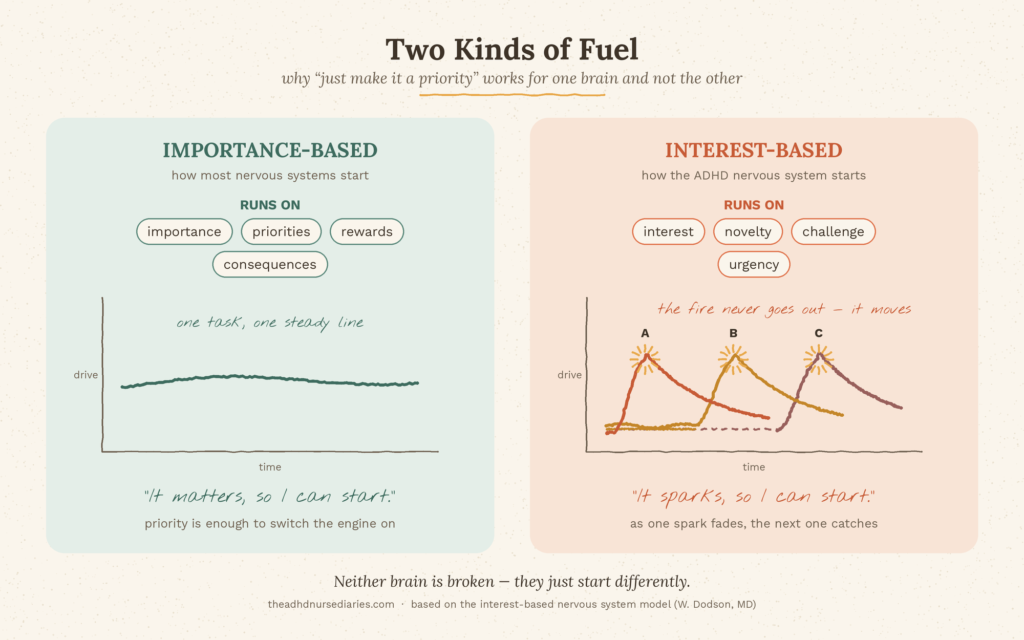
That single difference explains so much of my life. When something is new and fascinating, my brain floods with dopamine and I burn incandescent. But the moment a project shifts from passion into routine maintenance, I hit a wall. Strong start, weak finish — every single time. It’s why my beginnings are so bright and my middles so fragile.
And if I’m honest, it didn’t only shape my jobs. The same pattern moved through my marriage. I don’t say that to blame a diagnosis for a divorce — those are never that simple. But the rhythm is painfully familiar: once the unpredictable becomes predictable, boredom seeps in, the dopamine drops, and burnout follows close behind. The very thing that makes me light up is also the thing I can’t sustain on willpower alone.
ADHD job hopping: so what do I do with a brain like this?
I stopped fighting my wiring and started predicting it. This is where the grief and the hope finally meet.
I no longer believe these traits are defects to be fixed — and honestly, there’s no tidy cure on offer anyway. What’s helped me far more than any “fix” is this: instead of fighting the shape of my own nervous system, I’m learning to accept it first. To catch myself mid-spiral and say, almost gently, “Ah — there I go again. My passion and my dopamine are pouring themselves out right here.” I’ve carried this brain my whole life. It has earned a pat on the back and a rest, not another scolding.
And because it’s a genuine neurological difference — not a moral failing — I treat it like one. I take my medication, which genuinely helped. I keep getting to know myself. As the ADDA describes it, understanding how your ADHD brain works helps you build strategies that work with it, not against it (ADDA Editorial Team, “Inside the ADHD Brain…,” ADDA, April 23, 2026).
For me, “new approaches” means predicting and preparing instead of blaming. I know my risk points now, so I plan for them in advance. I know the dopamine will eventually fade at the new job. I know that when it does, I’ll start reaching for the excuse that the commute is “too far” to keep going. So I’ve made one rule for my sixth job: I’m prioritizing a workplace near somewhere I can get my dopamine in a healthy way — a dance class, twice a week. A job within reach of that class goes straight to the top of my list.
And maybe you caught it: the dance. The pop-star dream my fifteen-year-old self had to bury — I’m quietly digging a corner of it back up. Not as a career this time, but as medicine. The thing I was once told was foolish has become part of what keeps me well.
So do I grieve the lives I didn’t live? Honestly, less than I thought I would. The lawyer, the interpreter, the screenwriter — I’ve set them down, and I don’t ache for them. The one that still tugs at me is the dancing. I stepped away from it for a while, and I’ve missed it — but even that isn’t really grief anymore, because I’m already finding my way back to the floor. What I’m actually learning to put down isn’t the dreams. It’s the decades I spent blaming my character for what was always my wiring. And once you can finally tell those two apart, something deep inside you loosens its grip.
If you carry your own pile of unfinished dreams, I would love to hear them — along with the new, only-for-you approaches you’ve found for living with this brain. Share them in the comments. None of us should have to grieve alone.
This is my personal experience and general information, not medical advice. If grief, low self-worth, or burnout are weighing on you, please reach out to a clinician who understands ADHD — naming it with the right support can change everything.
Grace is a registered nurse with thirteen years of clinical experience — five in Australia and eight in Korea — who also lives with ADHD. She writes The ADHD Nurse: honest, first-person guides and diaries about working, parenting, and getting through the day with an ADHD brain. Everything here is her personal experience and general information, not medical advice.