I always read the phrase ADHD weight gain as something that happened to other people. Then my son flew home after his month-long visit, I stepped on the scale, and the scale — rude, but accurate — informed me I was 5 kg (about 11 lbs) heavier than when he arrived.
If you’re wondering whether ADHD and weight actually travel together, the short answer is: statistically, yes. In a meta-analysis of 728,136 people, 28.2% of adults with ADHD were obese, compared with 16.4% of adults without it (Cortese et al., 2016, American Journal of Psychiatry). That is not a moral report card. It’s an association — the same wiring that runs my attention also has opinions about my kitchen at midnight. This month I simply became one more data point in the chart.
So this diary is not a weight-loss guide, and I’m not about to sell you a plan. It’s the honest record of how one lovely month knocked my body off its rhythm, what the research says about why it showed up so fast — and the very small, very ADHD way I’ve started to answer it. Three minutes at a time.
Is ADHD weight gain actually a real thing?
Yes — as a pattern, not a prophecy. The Cortese meta-analysis pooled 42 studies and found that adults with ADHD had about 55% higher odds of obesity than adults without it (OR 1.55), and the association held even in studies that adjusted for age, sex, and other confounders.
Two honest footnotes, because I’m a nurse and I can’t help myself. First, association is not causation — nobody has proven that ADHD makes you gain weight; what we can say is that the two show up together far more often than chance. Second, a detail I want to hand to anyone who’s been blamed for their prescription: in that same analysis, people taking ADHD medication did not show additionally elevated obesity risk. The stigma line “the meds did this to you” doesn’t survive contact with the data.
What does make sense to me, from inside this brain, is the wiring story. Impulsivity doesn’t clock out at dinnertime. A reward-hungry brain doesn’t stop being reward-hungry at 11 p.m. — it just runs out of witnesses. And the executive function needed to plan meals, shop for them, and stop eating them is the exact function ADHD taxes all day long. It’s not weakness meeting food. It’s wiring meeting food, with nobody at the door.
Why did one month of late dinners show up so fast?
Because my whole schedule quietly moved to my son’s time zone. He’s a night owl — we stayed up talking past midnight, ate dinner at ten, sometimes eleven, and I loved every minute of it. But my own sleep cycle drifted along with his: later to bed, later to wake, dinner sliding deeper into the night. Most nights I ate and then, almost immediately, slept.
The bill arrived after he left. Sleeves suddenly snug around my forearms. A belly that hadn’t been in the picture before. And — this was the line for me — my knees started to ache on the stairs. Not dramatically. Just enough to say: this road keeps going downhill if you stay on it.
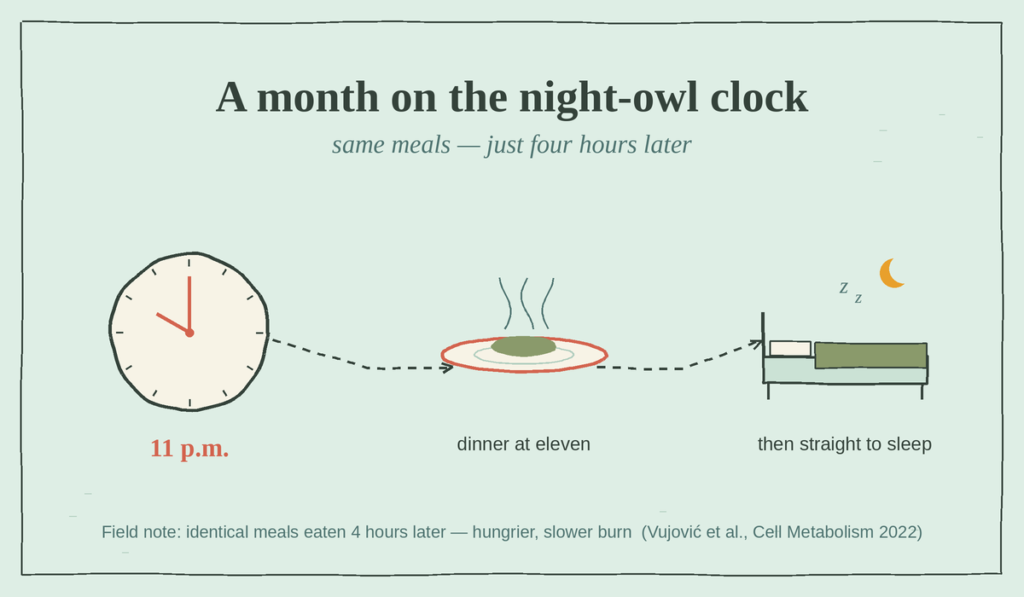
The research explains why one month was enough to feel it. In a tightly controlled crossover experiment, researchers had adults eat identical meals — same calories, same sleep, same activity — just four hours later in the day. Late eating made participants hungrier, lowered the energy they burned while awake, and shifted their fat-tissue gene activity toward storage (Vujović et al., 2022, Cell Metabolism). As first author Nina Vujović put it, “We found that eating four hours later makes a significant difference for our hunger levels, the way we burn calories after we eat, and the way we store fat” (“Eating late increases hunger, decreases calories burned, and changes fat tissue,” Brigham and Women’s Hospital news release, October 4, 2022).
Full honesty: that study had sixteen people in a lab. It’s a mechanism study, not a verdict on my kitchen. But it reads like the subtitle track for my August — same food, later clock, different body.
What finally made my dopamine care about this?
The knee did it — and then, unexpectedly, my dopamine showed up for work.
Here’s the part non-ADHD readers may not know: an interest-based nervous system doesn’t start projects because they’re important. Important has been shouting “lose the weight” at me for years, the way taxes shout, and I have looked politely past it every time. Interest-based brains start when something becomes interesting — and once it does, the same brain that couldn’t begin suddenly can’t stop. For whatever reason — the knees, the sleeves, maybe just the season turning — this project finally landed on my dopamine menu. The hyperfocus that once redecorated my house at 2 a.m. is now, apparently, available for this.
I’ve learned not to lecture this brain about timing. I’ve learned to move while the dopamine is in the room.
Is a three-minute walk even worth starting with?
Yes — and I mean three, not thirty. Here’s the whole plan, in its unimpressive glory:
One: dinner earlier, carbs down, protein up. I’m shifting dinner back toward daylight and trading some of the night carbs for protein. I want to be precise here: this is not a claim that this works, and not a plan I’m recommending — it’s an experiment with an n of 1, running in my own kitchen. I’ll tell you what actually happens.
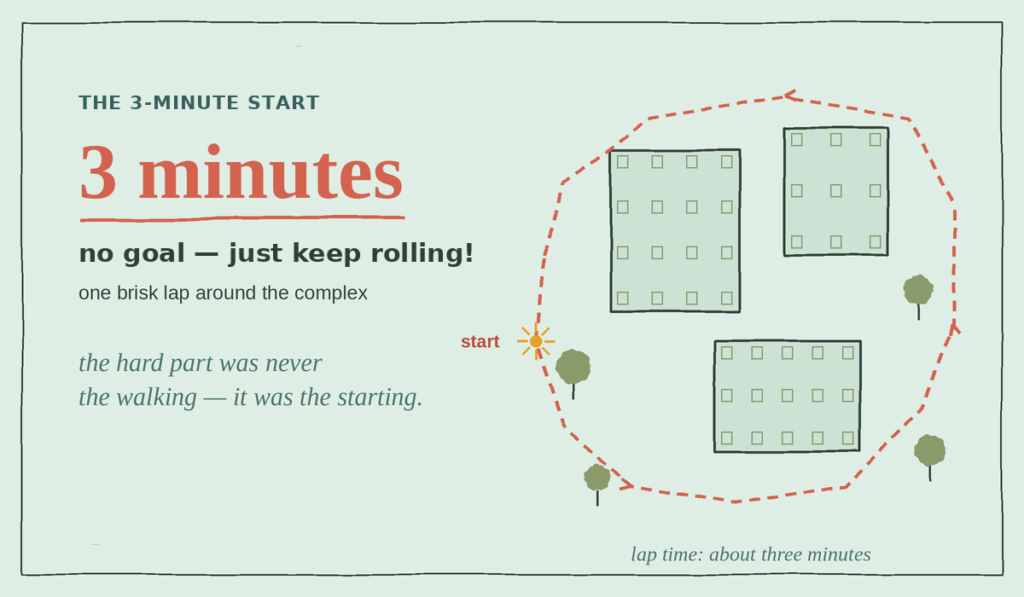
Two: no goal — just keep rolling. In Diary #2 I wrote about my aim 30 · start rule — aim at a goal, then start at 30% of it, because a perfectionist ADHD brain will otherwise wait forever for conditions worthy of 100%. This month I’ve gone one step further: no goal at all — because for this brain, even a goal is a quiet source of stress, a number to fall short of. That’s not the 30% rule failing; it’s the same self-knowledge, whittled one notch closer to fit. So I don’t aim at ten minutes and start with three — I just walk three minutes, one brisk lap around my apartment complex, and let it keep rolling. The weather has finally cooled enough that stepping outside is a reward, not a negotiation.
Three: laps between paragraphs. I work at a computer, which means my day is full of natural seams — end of a draft, end of a call. I’m dropping a three-minute lap into those seams instead of a snack.
And this is where the research handed me a gift. A Nature Medicine study followed 25,241 adults who did no formal exercise at all, tracking them with wrist sensors for nearly seven years. People who managed just three or four one-to-two-minute bursts of vigorous everyday movement per day — chasing a bus, taking a hill quickly — had a 38–40% lower risk of all-cause and cancer mortality, and roughly half the cardiovascular mortality risk, compared with people who had none (Stamatakis et al., 2022, Nature Medicine). As senior author Professor Emmanuel Stamatakis explains, “Upping the intensity of daily activities requires no time commitment, no preparation, no club memberships, no special skills. It simply involves stepping up the pace while walking or doing the housework with a bit more energy” (“One minute bursts of activity during daily tasks could prolong your life finds study,” The University of Sydney news, December 9, 2022).
“Upping the intensity of daily activities requires no time commitment, no preparation, no club memberships, no special skills.”
— Emmanuel Stamatakis, University of Sydney (2022)
No preparation. No time commitment. For a brain where the gym bag is where intentions go to die, that sentence is practically an ADHD accommodation.
Honest fine print, kept to one breath: the study tracked vigorous movement — brisk enough to get you breathing hard — and it’s observational, so association, not cause. But the finding I actually needed isn’t in the paper: the hard part was never the walking. It was the starting — and I’ve started. ADHD is an ignition problem, not a driving problem; the engine that takes forever to turn over runs beautifully once it catches. And with the dopamine finally flowing, three minutes has a way of not staying three minutes — the lap ends and my legs vote for one more. Short doesn’t mean zero. And started, for this brain, means rolling.
Where this diary lands
Not on a before-and-after photo. The month with my son was worth every late dinner, and I’d sign up for it again — the 5 kg isn’t a mistake to be ashamed of, it’s information. My body kept an accurate diary of a month I loved, and now it’s my turn to write the next entry.
So: no grand plan. Dinner a little earlier, protein a little more often, and three brisk minutes wherever they fit — starting now, while the dopamine is still in the room. I’ll report back in a couple of weeks, honestly, even if the scale refuses to participate in the narrative.
Has your weight ever quietly drifted along with your sleep — and what’s the smallest version of moving that you could actually start today? Tell me in the comments. Three minutes counts here.
This is my personal experience, not medical advice — please see my Medical Disclaimer for details. If weight, eating, or sleep feel unmanageable, an ADHD-informed clinician can help.
Grace is a registered nurse with thirteen years of clinical experience — five in Australia and eight in Korea — who also lives with ADHD. She writes The ADHD Nurse: honest, first-person guides and diaries about working, parenting, and getting through the day with an ADHD brain. Everything here is her personal experience and general information, not medical advice.