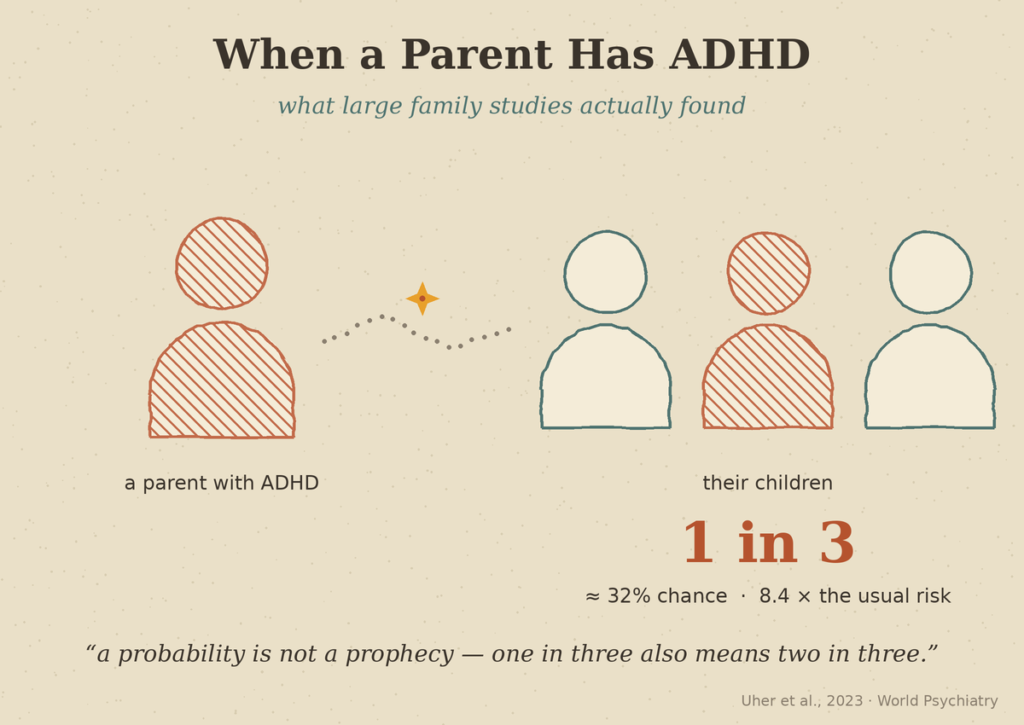
My grown son came home to stay for a month this summer, and somewhere between dinner and the ten-year-old variety shows we kept pulling up on YouTube, I finally let myself sit with the question I had been dodging: is ADHD hereditary? The short answer, according to the research, is yes — strongly. A meta-analysis of family high-risk and registry studies covering millions of parent–child pairs found that when a parent has ADHD, their child has about a 32% chance of being diagnosed with it too — roughly one in three — an 8.4-fold higher risk than children of parents without it (Uher et al., 2023, World Psychiatry — https://doi.org/10.1002/wps.21147). Of all the conditions in that analysis, ADHD showed the strongest parent-to-child transmission.
But here is the sentence I need you to read twice, because I had to: a probability is not a prophecy. One in three also means two in three. Those numbers describe populations, not my kitchen table. This diary is about the month I spent noticing what I’ve already handed my son — and deciding, on purpose, what I want to hand him next.
How do you survive a month-long houseguest when you have ADHD?
Short answer: you don’t survive it on willpower — you survive it on systems. And for the first time, mine actually held.
Let me be honest about the setup. The house was fuller than usual, the schedule was tighter, and there was suddenly one more adult human generating dishes, laundry, and lovely unplanned conversations. Old me would have quietly unraveled by week two — smiling at dinner, doom-piling in private.
This time, three things held the line. My co-working sessions with Claude kept working like a body double: whenever a question popped into my head mid-task — wait, is that ingredient safe? what was that word? — I asked it right there instead of falling down a forty-minute rabbit hole. My clear storage bins kept the baseline of the house standing, because when everything has a visible address, a busy month rearranges the surface but not the system. And when the tiredness hit, I stopped pushing through it. I crawled under my weighted blanket and slept — really slept. Some mornings I woke up later than my grown son, the one who was supposedly here on vacation. (I have decided to count that as a win, not a scandal.)
Here’s what surprised me most: when my body stopped bracing, my mind stopped bracing too. The irritability I used to blame on my personality turned out to be, in large part, exhaustion wearing my face.
What does handing down a system actually look like?
It looks smaller than you’d think. For his travels, I gave my son a passport wallet — and before you picture something sentimental, it was really a philosophy in fabric form.
Into it went not just the passport, but everything he’d need in the first hour after landing: the SIM card, the transit card, the little things that otherwise scatter across three pockets and one panicked search at the airport. It’s the portable version of the rule that saved my house — give every object an address, so your brain doesn’t have to be the address. If you’ve read my doom pile confessions, you know this rule cost me years to learn.
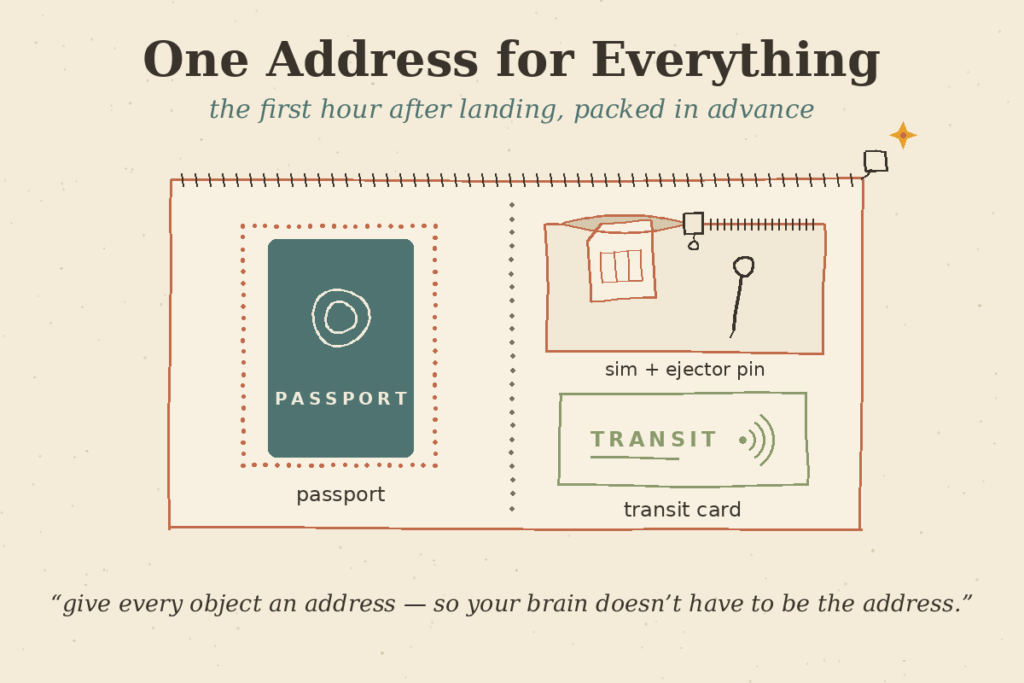
He used it. It helped. And watching him zip that wallet shut, I felt something I didn’t expect: I wasn’t just giving him a gift. I was handing down twenty years of workarounds, folded into one object. Which is exactly when the harder question walked in.
Is ADHD Hereditary — and Did I Pass It to My Son?
Direct answer: I don’t know, and I’m not going to guess. What I know is the math — that 32% (one in three) and that 8.4-fold risk — and the fact that numbers this size mean the question deserves respect, not panic.
A few weeks ago I climbed up my family tree. My late diagnosis explained me — and my parents, too; I dug into the heritability research there, and looking backward gave me compassion for a generation that never got answers. This month, for the first time, I looked down the tree. Same wiring question, opposite direction — and a completely different feeling in the chest.
Because here’s the thing: I will not diagnose my son over a month of shared dinners and old TV clips. That’s not how diagnosis works, and it’s not my call to make — not as his mother, and not even as a nurse. A number like 32% is a reason to keep a door open. It is not a reason to push someone through it.
How do you talk to your adult child about ADHD without pushing?
The experts’ answer is almost unanimous: you don’t argue anyone into it. CHADD’s guidance for families is blunt on this point — Wayne State University psychiatry professor Arthur Robin’s first rule is do not try to argue them into seeking treatment; instead, affirm what’s good in them, help them name changes they want, and simply ask whether they’d be open to support in getting there (CHADD, “What to Do When Your Loved One Doesn’t Want Help,” ADHD Weekly, updated August 3, 2023 — https://chadd.org/adhd-weekly/what-to-do-when-your-loved-one-doesnt-want-help/). As Dr. Robin puts it, “This type of therapy helps people who resist making changes examine themselves and sometimes successfully overcome their resistance to change without it being ADHD treatment.”
“This type of therapy helps people who resist making changes examine themselves and sometimes successfully overcome their resistance to change without it being ADHD treatment.” — Arthur Robin, PhD, Wayne State University
In the same article, author Gina Pera adds a reframe I needed: what looks like denial is often really “misperceptions about ADHD and stigma issues, along with defenses built up around receiving lifelong criticism.” Not stubbornness — scar tissue.
So this is what I actually said to my son, on one of those evenings — dishes done, a decade-old variety show playing on YouTube. Not “I think you have ADHD” — never that. I told him that simply taking a temperament screening — even with no diagnosis anywhere in sight — can make your own behavior legible to you, and that once you understand why you do what you do, coping gets easier. I mentioned that free, short screeners exist, like the WHO’s six-question adult ADHD screener — a screening tool, explicitly not a diagnosis (Kessler et al., 2005, Psychological Medicine — https://www.media.psykab.se/2014/01/Kessler2005ASRS-PsychMed.pdf). I told him that if ADHD is part of his wiring, finding out earlier is simply easier than finding out at my age. And then I offered the only thing that was truly mine to offer: if you ever want to look into it, let’s find a clinic that fits you — together.
He didn’t have to say yes on the spot. That was the whole point. Parenting with ADHD doesn’t end when your child grows taller than you; it just changes from steering to standing nearby with the map, in case they ask.
What I may have passed down — and what I can pass down on purpose
I can’t edit the genetic lottery. Whatever my son inherited from me was decided long before I understood my own brain, and no amount of guilt rewrites a genome — guilt, I’ve learned, is just worry wearing a costume of usefulness.
But this month taught me the other half of the inheritance question. The bins, the blanket, the body double, the wallet with an address for everything — none of that was in his DNA. All of it crossed the generations anyway, over dinner and decade-old variety shows, in a full house, during one ordinary month. Genes are what I may have passed down. Systems and self-understanding are what I can pass down — deliberately, with both hands.
If the wiring did travel, he won’t be starting where I started. He’ll be starting where I am.
Your turn: have you ever wondered whether you passed your wiring to your kids — and if you’ve had that conversation, how did it go? I’d genuinely love to hear it in the comments.
This is my personal experience, not medical advice. If any of this feels familiar, an ADHD-informed clinician can help — screeners raise questions, but only a proper evaluation answers them. Please see my full Medical Disclaimer.

Grace is a registered nurse with thirteen years of clinical experience — five in Australia and eight in Korea — who also lives with ADHD. She writes The ADHD Nurse: honest, first-person guides and diaries about working, parenting, and getting through the day with an ADHD brain. Everything here is her personal experience and general information, not medical advice.