For thirteen years, ADHD at work meant one simple rule for me: nothing important was allowed to live only in my head. That’s the whole answer, right up front. I was a ward nurse, my working memory leaks like a paper cup in the rain, and patients don’t get second chances on medication times. So I moved every must-not-miss time and detail out of my brain and into places my eyes couldn’t avoid — marker notes on my forearm, alarms stacked in threes, routines drilled until they ran on their own.
None of it was elegant — my forearm looked like a doodle pad that had wandered into a hospital. But my patients got their meds on time, every time. And years later, I learned that medicine as an institution had quietly agreed with my method all along.
This is what working with ADHD actually looked like on the ward, why it worked, and what happened when I traded my scrubs for a home office.
How do you manage ADHD at work as a nurse?
Direct answer: you stop trusting your memory and start building things your memory can’t ruin. For me, that started with a pen.
I started by writing critical reminders on my palm — terrible real estate, since the note vanishes the moment you close your hand. I moved to the back of my hand, which worked until you remember that nurses wash their hands roughly nine hundred times a shift; by mid-morning everything was a gray smear. So I migrated up and settled on my forearm. A notepad can be lost or left at the nurses’ station. A forearm is always exactly where you left it.
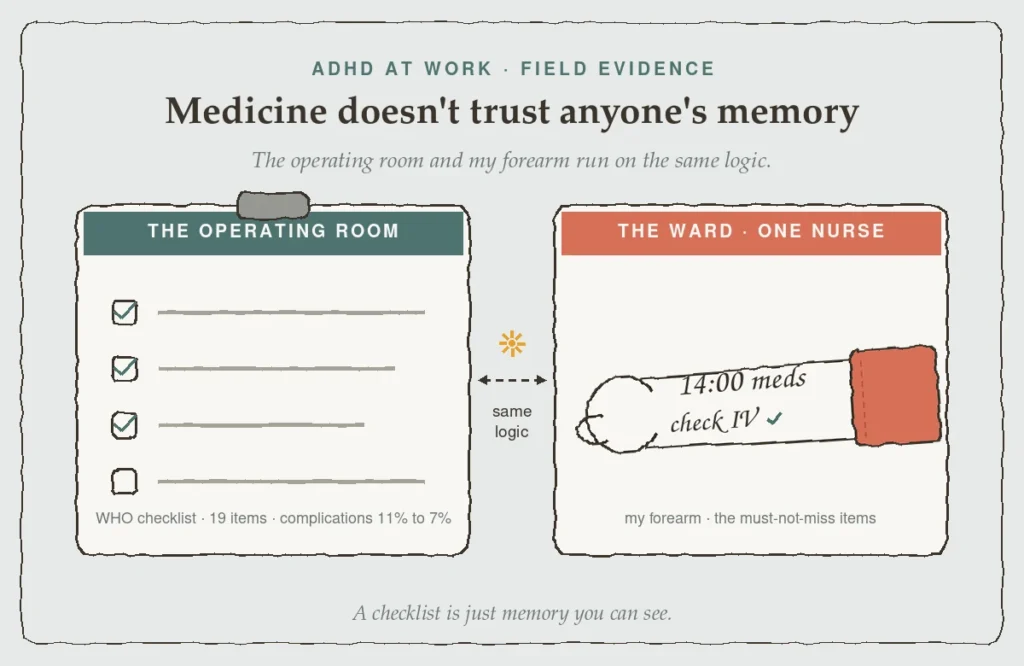
Here’s the actual trick, and I want to be precise: I never copied my whole task list onto my arm. I picked out only the times and details that absolutely could not be missed — a 14:00 med due, a specific detail to double-check — and wrote them big and visible. The goal wasn’t to remember. The goal was to make it impossible not to be reminded. It was a passive system, not an active one: the information sat in my line of sight and ambushed me, over and over, until the thing was done. When the stakes are medication details, “I’ll try to remember” is not a plan.
And no, I wasn’t hiding any of this. I’ve masked my way through plenty of social settings, but nursing is a team sport: my weak spots were public information from day one, and honestly, that was better. The ward left no room to perform anyway.
Do reminders and alarms count as cheating?
Direct answer: no — and cognitive science has receipts.
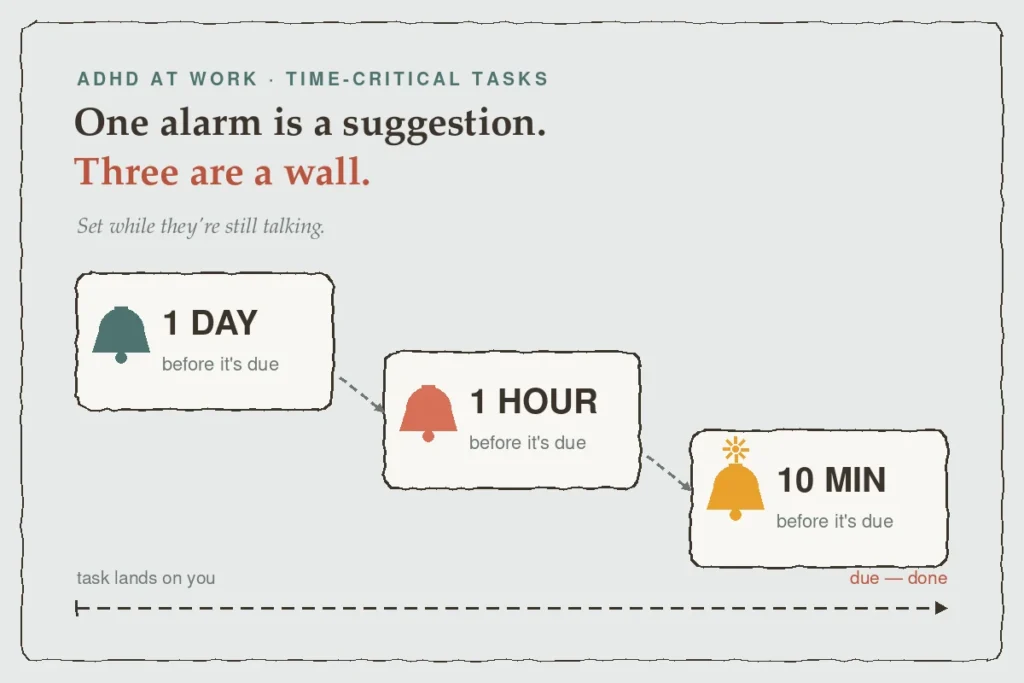
For anything time-critical, the pen wasn’t enough. The moment a timed task landed on me, I set phone alarms in a cascade: one the day before, one an hour before, one ten minutes before. If someone mentioned something to check on a different day, the alarm was set while they were still talking. Three layers, because one alarm is a suggestion and three are a wall.
I used to feel a little sheepish about all this scaffolding, like I was passing an exam with the textbook open. Then I found the offloading research. As Dr. Annika Boldt of the UCL Institute of Cognitive Neuroscience put it, “Cognitive offloading is often seen as a sign of noncompliance in psychology… Whereas here we show that it’s actually a highly strategic process of balancing both the internal and external resources that you have available to you” (Laura Mickes, “For a cognitive boost, offload it: Interview with Boldt and Gilbert,” Psychonomic Society Featured Content, May 6, 2020).
“Cognitive offloading is often seen as a sign of noncompliance in psychology… Whereas here we show that it’s actually a highly strategic process of balancing both the internal and external resources that you have available to you.” — Dr. Annika Boldt, UCL Institute of Cognitive Neuroscience (2020)
Strategic. Not lazy — strategic, for someone like me whose internal reminder signal keeps cutting out. In the same Psychonomic Society interview, host Laura Mickes — a memory researcher at the University of Bristol — draws an arrow on her own hand so she won’t forget her luggage on the train. Scientists write on their hands too. I just had more to carry.
What does a surgical checklist have to do with my forearm?
Direct answer: my arm was a one-person version of something medicine already institutionalized — because medicine doesn’t trust anyone’s memory.
This was my real turning point, and it came from a paper, not a pep talk. In a study across eight hospitals in eight countries, the WHO Surgical Safety Checklist — nineteen items, most of them things every professional already “knew” — dropped inpatient deaths from 1.5% to 0.8% and major complications from 11% to 7% (Haynes et al., 2009, New England Journal of Medicine).
Sit with that. Surgeons and nurses at the top of their field, and the system still assumes their memory will leak under pressure — so it bolts the critical steps to a piece of paper where eyes can’t avoid them. Sound familiar?
That’s the day my self-image quietly rewrote itself. My marker-stained arm wasn’t a messy workaround — it was surgery’s safety logic, borrowed by one ward nurse who never set foot in an operating room. Not a crutch. An ace move I’d invented out of necessity, years before I knew the evidence existed.
How long does it take to build a routine that actually holds?
Direct answer: longer than the productivity gurus promise — and that’s fine, because the range is enormous.
Even with the arm and the alarms, I still dropped things. Eventually my supervisor gave me homework I did not appreciate at the time: go home and simulate your entire shift routine, start to finish. I was hurt. It was also the most useful assignment of my career. Rehearsing the fixed routine at home meant that on the ward, the routine ran itself — and only when the routine is automatic do you have spare capacity for the new instructions that land on you every single day. You can’t stack surprises on a wobbly base.
The habit research backs the homework. In a study of everyday habit formation — ordinary adults, I should note, not an ADHD sample — behaviors took a median of 66 days of repetition in the same context to become automatic, with individual ranges from 18 to 254 days (Lally et al., 2010, European Journal of Social Psychology). Same action, same context, repeated until it stops costing attention — exactly the homework.
I turned it into a personal rule I still carry: rehearse like a simulation robot — same input, same output, every time. New job? Same drill.
What happened when I took my ADHD home?
Direct answer: everything took me twice as long as everyone else — and for once, I didn’t panic about it.
When I left the ward and became an online seller (the why is its own story — see my job-hopping post), I expected the adjustment to take me double the usual time. It did. And because I’d budgeted for it, there was no spiral, no stress — just the plan, running slowly. Remember that habit range — 18 to 254 days: a fourteen-fold spread among people without ADHD. “Twice as long” isn’t broken; it’s inside the distribution.
But working from home handed me something the ward never could: room to stop following instructions. I let myself do things my own strange way, took the long road around almost everything — and the long road turned out to be scenic. I stumbled through more corners of the online business world than any tutorial would have shown me, and I’m already dreaming about a different field next year. (These days my co-worker is an AI — a story of its own.)
The asset inventory
If I’ve learned one thing about ADHD in the workplace, it’s that the most important ingredient is stubborn consistency. You have to hit your limits before you invent a way over them, and the more walls you show up to, the more inventions you collect. The forearm notes, the cascading alarms, the simulation-robot rehearsals: every one of them was born from a faceplant. Every new job will bring new walls. I’ll solve them the ADHD way, one weird workaround at a time, and each one goes into my asset inventory for whatever comes next.
Koreans have a slang word for this kind of endurance — jonbeo — which translates, politely, to “hold on ferociously.” That’s the whole strategy, really. Hold on ferociously, collect your workarounds, and let your arm be a doodle pad if that’s what keeps the important things safe.
So tell me — what’s the wall you’re up against at work right now? And what’s the strangest workaround in your asset inventory?
Let’s live each day well, one marker note at a time.
This is my personal experience, not medical advice. If work struggles feel bigger than notes and alarms can fix, an ADHD-informed clinician can help. Please see my full Medical Disclaimer.

Grace is a registered nurse with thirteen years of clinical experience — five in Australia and eight in Korea — who also lives with ADHD. She writes The ADHD Nurse: honest, first-person guides and diaries about working, parenting, and getting through the day with an ADHD brain. Everything here is her personal experience and general information, not medical advice.