I was fluent in ADHD masking long before I ever learned the term — and nowhere more fluently than at the nurses’ station. ADHD masking (researchers call it camouflaging) is the conscious or unconscious effort to hide, suppress, or compensate for ADHD symptoms so you appear to function “normally” — nodding calmly through handoff while your brain runs six tracks at once, triple-checking a chart so nobody sees how hard focusing actually is, saying “I’m fine” in the exact tone that ends the conversation.
In thirteen years as a registered nurse — five in Australia, eight in Korea — I filed all of that under professionalism. Patient safety culture doesn’t leave much room for “sorry, my attention slid off the med sheet.” So I built a second self for work: calmer, quieter, endlessly agreeable. The mask worked. That was the problem.
And it turns out I have company. In a 2026 Simon Fraser University study, 91.6% of 202 adults with ADHD reported camouflaging their symptoms (Mylett et al., 2026, Research in Neurodiversity). If you’ve ever come home from an ordinary social event feeling like you just worked a double shift, this post is for you.
One honest disclosure before we start: of every topic I’ve written about here, this was the hardest one to look at objectively. It resembles me too much.
What Is ADHD Masking, Exactly?
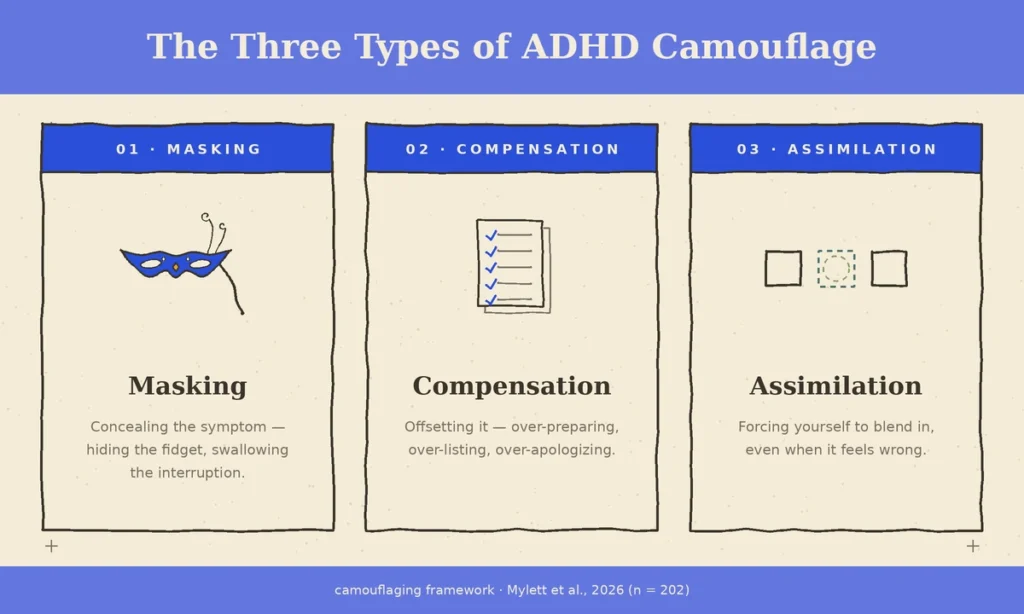
ADHD masking is not an official diagnosis or a term you’ll find in the DSM — it’s a lived-experience concept that research is only now catching up to. In the literature, camouflaging is usually broken into three flavors: masking (concealing symptoms — hiding the fidget, swallowing the interruption), compensation (offsetting them — over-preparing, over-listing, over-apologizing), and assimilation (forcing yourself to blend in even when it feels wrong).
Worth knowing: this framework was built for autism research first, and the science on ADHD is genuinely young. One comparison study found that adults with ADHD camouflage more than neurotypical controls but less than autistic adults — and that the standard questionnaire, designed around autistic experience, may simply miss ADHD-specific masking like hiding hyperactivity or impulsivity (van der Putten et al., 2024, Autism Research). A commentary in The British Journal of Psychiatry goes further and cautions that the concept needs proper validation before clinics start using it.
So this is emerging research, not settled science. But “the researchers are still measuring it” has never once stopped a phenomenon from being exhausting.
Why Do People with ADHD Mask?
The short answer from the SFU study: to fit in, to be liked, to avoid bad experiences, and — participants’ own words — to survive and succeed in a neurotypical world. The behaviors they described are almost embarrassingly familiar: suppressing the fidget, performing a “focused” face, biting your tongue so you don’t interrupt, rehearsing conversations in advance, mirroring whoever is in front of you. Many participants said these habits had become so automatic they no longer felt like a choice.
That’s the part that gets me. Masking isn’t a costume you put on — it’s a starter motor that switched itself to always on somewhere around third grade.
If you want to see mine in the wild, just ask me where I want to eat. My answer — every time, on reflex — is “I’m fine with anything.” It’s practically my catchphrase. I’ve spent so many years deferring to whatever everyone else was craving that somewhere along the way I lost the answer myself: I honestly couldn’t tell you what my favorite food is. Not because I don’t have preferences — because the muscle that notices them quietly went out of use. That’s how automatic this gets. I wasn’t even masking a symptom anymore; I was masking wanting things.
Masking doesn’t just install itself, either — it gets reinforced from the outside, one piece of feedback at a time. A friend once told me I was over-reacting, that I leaned on the language of empathy too much. She wasn’t being unkind, and honestly, she may have had a point. But here’s what that kind of comment does to a brain already scanning every room for cues: it doesn’t teach you calibration. It teaches you that your natural setting is too much. So you don’t turn the volume down a notch — you mute the channel entirely, and file one more feeling under keep to yourself.
And the bill arrives eventually. Participants reported exhaustion, identity confusion, and feeling less close to the very people they were masking for. Even after controlling for age, gender, and ADHD traits, camouflaging remained significantly linked to social anxiety. As lead author Marisa Mylett explains in the university’s announcement (“Adults with ADHD may pay high price to mask traits and fit in, SFU study finds,” SFU News, June 2026), “Camouflaging or masking strategies may help you get your foot in the door socially, in relationships or at work, but they often leave people feeling exhausted, disconnected from their true selves and less close or connected to others.”
“Camouflaging or masking strategies may help you get your foot in the door socially, in relationships or at work, but they often leave people feeling exhausted, disconnected from their true selves and less close or connected to others.”
— Marisa Mylett, Simon Fraser University (2026)
To be fair, masking isn’t purely villainous. It genuinely opens doors — jobs, friendships, first impressions. The problem isn’t the mask; it’s never being allowed to take it off.
Why Are Women with ADHD Diagnosed So Late?
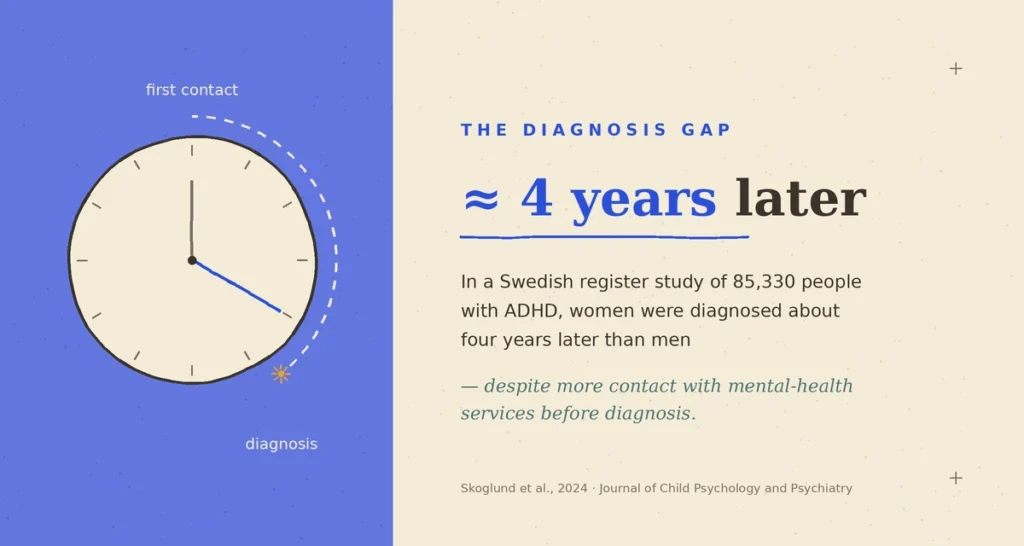
Largely because girls are trained to mask before anyone thinks to look underneath. In a Swedish register study of 85,330 people diagnosed with ADHD, women were diagnosed roughly four years later than men — despite having more contact with mental health services before diagnosis (Skoglund et al., 2024, Journal of Child Psychology and Psychiatry). We were in the waiting room the whole time. Somebody just kept treating the mask.
I know exactly which mask they were treating, because I wore it: the good girl mask. Don’t look upset. Read the room twice before you speak once. Keep everyone comfortable, whatever it costs you. My compensations even looked like virtues — the endless lists, the rehearsed phone calls, the perfectionism that everyone praised right up until it quietly fell apart. And when something did upset me, the rule was simple: be fine anyway. (If “being fine anyway” is your cardio, my post on emotional dysregulation will feel familiar.)
The cruel math of the good girl complex is this: the better a girl masks, the less she looks like she needs help — so the reward for doing it well is invisibility.
Does ADHD Masking Cause Burnout?
The honest answer: emerging research points that way, but nobody can claim proof yet — and “ADHD burnout,” like masking, is a community term, not an official diagnosis. What the SFU participants described is a pattern many of us know by heart: constant depletion, rising anxiety, and a strange distance from the person doing all that performing. Notably, suppressing natural coping behaviors — the fidgeting, the pacing, the movement — seemed to make symptoms worse, not better.
Clinicians commonly describe an ADHD burnout cycle: over-commit, run on willpower, crash, recover just enough, repeat (“ADHD Burnout: Cycle, Symptoms, and Causes,” ADDA). The early warning sign I’d flag from my own nursing years is sneaky: the strategies that always worked suddenly don’t. The planner stops helping. Starting anything feels like lifting a car. On night shifts, I assumed that was just shift work. Some of it was. Not all of it.
How Do I Stop Masking My ADHD?
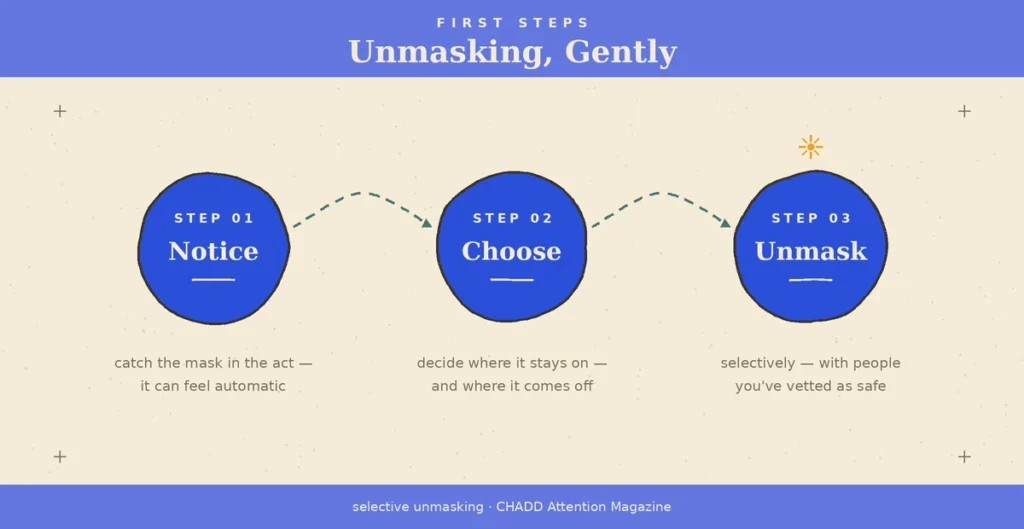
You start by noticing — and you don’t have to unmask everywhere. CHADD’s advice is the most practical I’ve found: first catch yourself in the act, because masking can feel so “normal” you don’t register doing it; then practice selective unmasking — deliberately choosing where the mask stays on and where it comes off, with people you’ve vetted as safe (“Parent ADHD Unmasked,” CHADD Attention Magazine). Alongside that: swap the strategies that run on self-suppression for ones that run on structure — calendars, reminders, movement breaks, a quiet fidget tool instead of a white-knuckled stillness. And if you’re seeking an assessment, document your effort, not just your achievements — looking successful has hidden a lot of ADHD from a lot of clinicians.
The noticing step is where I actually am. Reading the SFU study, I kept catching my own reflection: pretending not to mind things I minded, scanning every face in the room before letting a sentence out. My personal rule for unmasking, so far, is this — I take the mask off with people who can actually understand me. For me that’s my church and family communities: relationships with enough shared history, and enough patience, that communication can happen slowly and honestly. Where else, and how much? Genuinely still figuring that out. I’m not writing this from the far side of unmasking; I’m writing it from the middle.
Here’s where I land tonight: the mask was never a character flaw. It was a survival skill, built by a kid who noticed — accurately — that the room preferred her quieter. I’m allowed to thank that kid and still put the thing down sometimes.
So tell me, honestly: where did you first learn to wear your mask — and who’s on the short list of people who get to see you without it? I’ll be in the comments, unmasked-ish.
This is my personal experience, not medical advice. If masking and exhaustion are wearing you down, an ADHD-informed clinician can help you sort healthy adaptation from self-suppression.

Grace is a registered nurse with thirteen years of clinical experience — five in Australia and eight in Korea — who also lives with ADHD. She writes The ADHD Nurse: honest, first-person guides and diaries about working, parenting, and getting through the day with an ADHD brain. Everything here is her personal experience and general information, not medical advice.