If you had told me three years ago that my adult ADHD diagnosis would begin with grief, I wouldn’t have believed you. But that’s exactly how it happened — a sudden loss, a complicated year, a burnout I couldn’t name, and then, at the end of it, an answer.
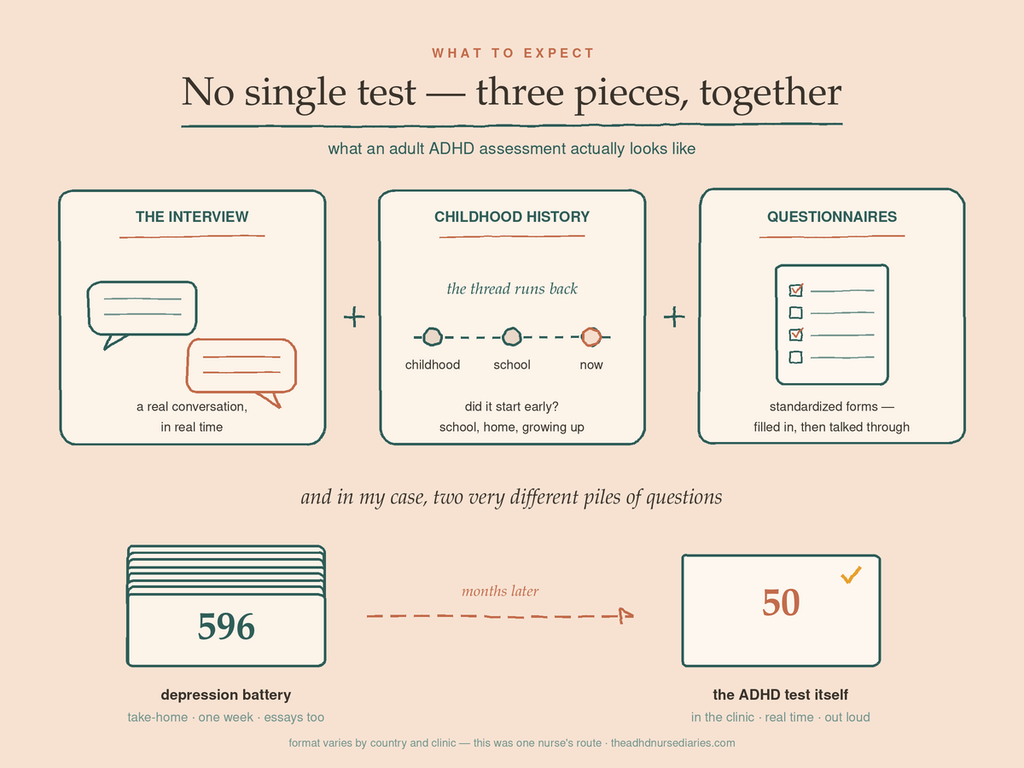
The short version, for anyone searching “what to expect”: there is no blood test or brain scan for ADHD. According to the NHS, an adult assessment is a clinical interview with an ADHD specialist — your childhood history, how symptoms shape work and relationships (NHS, “ADHD in adults,” NHS.uk, reviewed March 19, 2025 ). Clinics often add standardized questionnaires on top — mine certainly did. The twist my title hides: the ADHD test itself was the short part — about 50 questions. The 596-question marathon came earlier, and it deserves its own scene.
I’m a registered nurse. I’m also the patient in this story. Quick note: this is my personal experience, not medical advice.
How does an adult ADHD diagnosis actually start?
Honestly? Mine didn’t start with ADHD at all. It started with a loss — and with people who loved me enough to say something.
After the loss and the complicated year that followed, I couldn’t sit with my own feelings. I filled every empty hour with people, plans, movement — not healing, just drifting — until the burnout arrived like a bill I’d been ignoring.
My church community gently pushed me toward a psychiatric clinic. Even then, the threshold was high: as a new patient I would have waited two months. One old record — a single visit two years earlier — was the only reason the door opened quickly.
The clinic’s first move wasn’t an ADHD test but a full evaluation for depression — and it came with homework: a standardized battery of 596 questions to complete within a week. Many were open-ended. Essay questions, about my own brain.
Now, the most ADHD scene of this story. Did I thoughtfully fill in a few pages each evening? I did not. On the deadline’s final day, I drove straight from work, parked in front of the clinic, and answered all 596 questions in my car — two hours, hazard-lights energy, submitted with minutes to spare. And it may have been the most accurate thing I’ve ever done: no time to polish my answers or guess what a “normal” response would look like. What went onto those pages was unfiltered — my actual patterns, exactly as they are.
The diagnosis that came back was severe depression. (If you’re in that place right now, please don’t carry it alone — reaching out for professional or crisis support is a strong move, not a weak one.) Months later, when the depression had eased to mild, I did something that still surprises me: I asked for the ADHD evaluation. My community had already been hinting at it. The traits were visible from the outside long before I was ready to look at them from the inside.
What does an ADHD assessment for adults actually look like?
Direct answer: a clinical interview plus your childhood history — the exact format varies by country and clinic. There’s no single definitive test; specialists look at whether symptoms started early and how they affect daily life. What surprised me most: after the take-home 596-question depression battery, the ADHD test couldn’t have been more different — about 50 questions, done right there in the clinic, in real time, with my doctor across the desk. The heavy lifting had already happened; this one simply asked the right questions, out loud.
What did it feel like to finally hear the diagnosis?
And this time there was no waiting: the moment the 50th question was answered, my doctor gave me the result on the spot. And the feeling wasn’t fear. It was relief — the specific relief of learning that I wasn’t strange; there had always been a reason I worked this way.
Something quietly enormous happened next. I could suddenly understand my own situations — even predict them. I knew where I’d struggle before I struggled — I could prepare instead of just brace. And one lifelong pressure finally lifted: the rule that everything must be done in priority order. My brain has never run on priority order. Once I knew my wiring was simply different, I stopped grading myself against an operating system I was never issued.
Here’s the part I only understood later, nurse hat on. My ADHD traits had been in plain view from my first regular visits — and I’m fairly sure my doctor saw them long before I said the word. She never pushed. She waited for me to ask. That patience bought something no prescription pad can: adherence. I take my medication faithfully — partly the nurse in me, but mostly because the insight was mine first. A diagnosis pushed onto a patient gets resisted; one the patient opens the door to gets kept. It’s the same reason I try not to push this conversation on my own son.
The research says my relief is the rule, not the exception. In a qualitative study of 21 adults diagnosed with ADHD in adulthood, 20 of 21 reported major positive consequences of the diagnosis — and when asked directly, not one person regretted being evaluated (Hansson Halleröd et al., 2015, BMC Psychiatry ). One participant put it in words I could have written myself: “It was the answer to many years of wondering.”
“It was the answer to many years of wondering.” — Study participant, Hansson Halleröd et al. (2015)
It wasn’t all sunshine in that study — some participants also felt sadness or worried about limits, and I understand that. What a late ADHD diagnosis explains about your past — and your family’s — even reshaped how I talked with mine about whether ADHD is hereditary. But regret? None here either.
Does ADHD medication actually change anything?
For me — yes, and I want to describe it carefully, precisely because I’m a nurse.
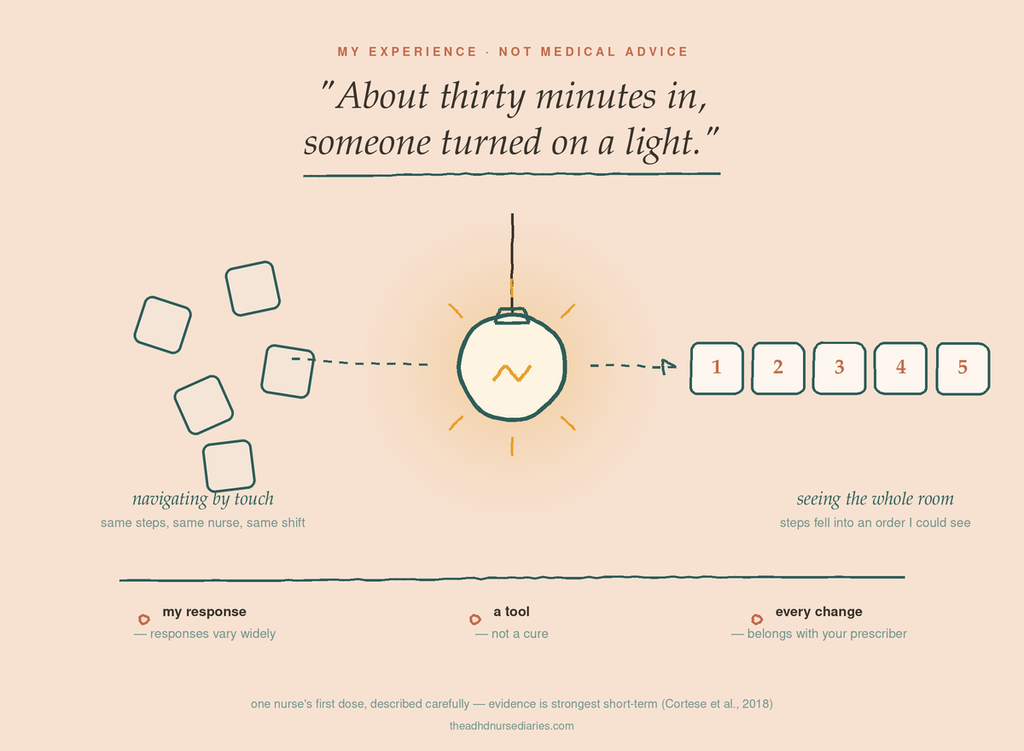
I took my first dose of ADHD medication, a stimulant, on a workday. About thirty minutes in, it felt like someone turned on a light in a room I’d been navigating by touch. My field of view widened; steps arranged themselves into an actual, systematic order without me wrestling them into place. I finished that shift without a single mistake. Even my emotions steadied — partly because I could finally see myself coming. (More in my emotional dysregulation post.)
Now the careful part. That was my response — responses vary widely, and medication is a tool, not a cure. The largest network meta-analysis to date — 133 randomized controlled trials including 10,296 adults — found that most ADHD medications outperformed placebo for adult symptoms over 12 weeks (Cortese et al., 2018, The Lancet Psychiatry — DOI). The same study is honest about the limits: the evidence is short-term, and medications were somewhat less effective and less well tolerated in adults than in children.
My honest footnotes match the data. Appetite suppression is a documented side effect, and I had it — barely a problem during the day. The catch came in the evenings: as it wore off, my appetite rebounded hard, I ate late, and yes, I gained some weight. (My ADHD weight gain post? This was the hidden backstory.) Access is a real, unglamorous problem too: after I left my job the clinic was far away, and on days I couldn’t get my prescription filled I felt unsettled and deeply tired. So I’ll say this plainly: I never adjusted or paused doses on my own — please don’t either. Those decisions belong with you and your prescriber, always.
Is it worth getting assessed as an adult?
I can’t answer for you. But I can tell you what happened to my friends.
After my diagnosis, I nudged several friends with the same wiring toward getting assessed. A few did. Every one has said some version of the same sentence: “If I’d started sooner, life with my family, my friends, my job — all of it would have been so much easier.” In that same 2015 study, 12 of 21 participants said their one disappointment was not being diagnosed earlier.
The threshold is real — the waitlists, the 596 questions, the vulnerability of it all. But thresholds are just doorways you haven’t crossed yet. And on the other side of this particular door, there may be the answer to many years of wondering.
Have you been assessed as an adult — or are you standing at that door, deciding? Tell me in the comments. I read every one, and this is a safe place to be undecided.
This post describes my personal experience with ADHD diagnosis and medication — not medical advice or a recommendation for or against any treatment. Never start, stop, or adjust medication without your prescribing clinician. If you think you may have ADHD, an ADHD-informed clinician is the right place to start. See my full Medical Disclaimer.
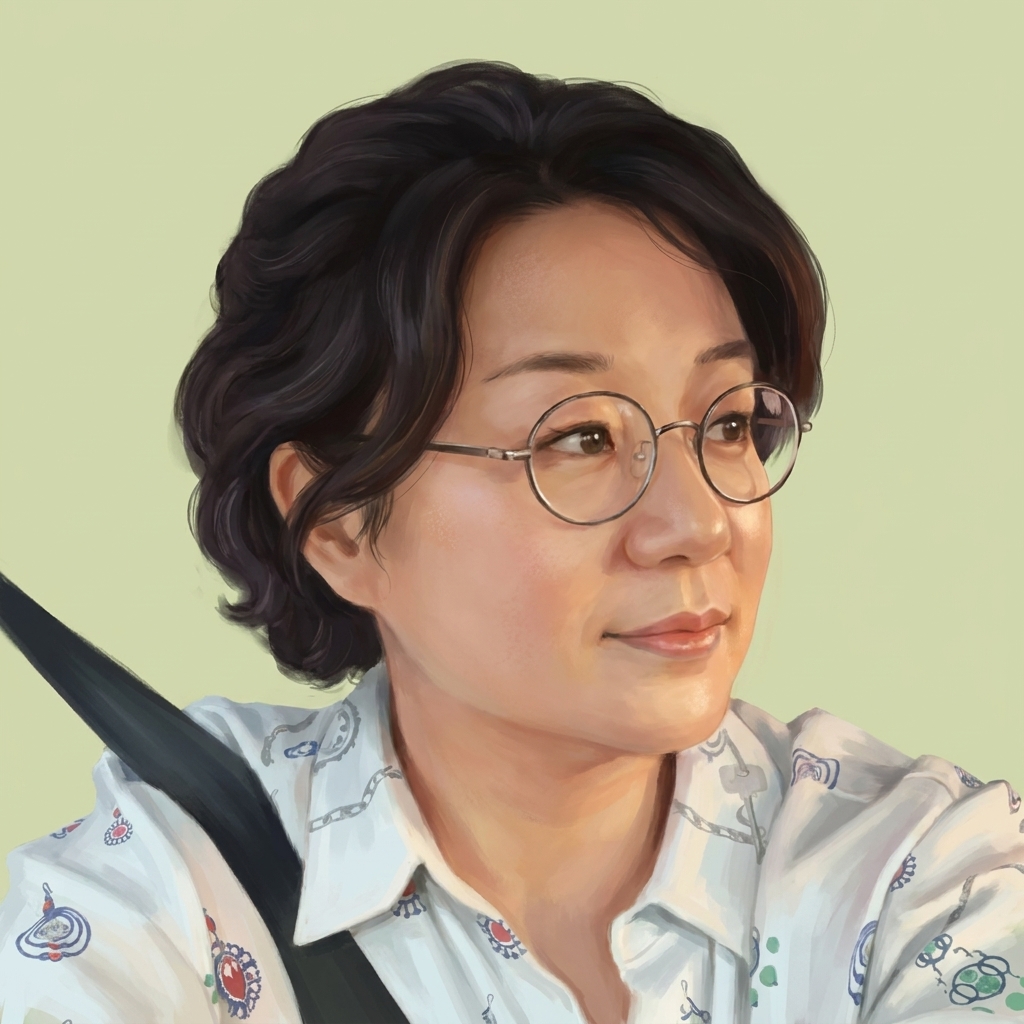
Grace is a registered nurse with thirteen years of clinical experience — five in Australia and eight in Korea — who also lives with ADHD. She writes The ADHD Nurse: honest, first-person guides and diaries about working, parenting, and getting through the day with an ADHD brain. Everything here is her personal experience and general information, not medical advice.