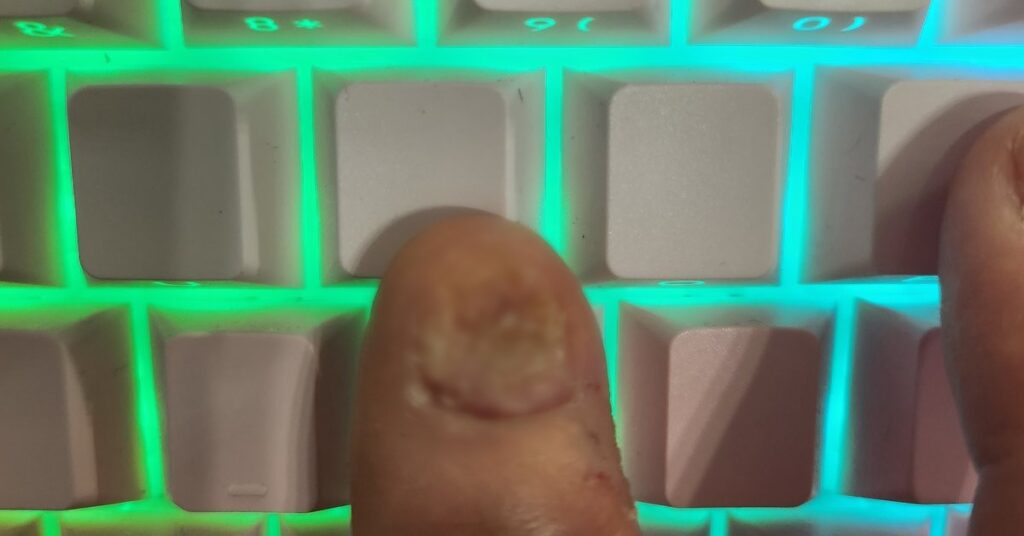
ADHD nail biting started early for me: when I was little, my younger brother and I were such committed nail-biters that we used to run out of nails. All ten fingers — gone. So, and I promise this is true, we’d move on to our toenails. We were small and bendy enough to fold a foot right up to our mouths, and we absolutely did.
Our father was horrified. His fix was to make us write apology letters: “I promise I will not bite my nails and toenails, which are dirtier than poop.” We copied that line out, over and over, for years.
Reader, we still bite our nails sometimes. (Sorry, Dad.)
So if years of apology letters couldn’t fix it, maybe it was never really about willpower. Here’s the short answer to why you can’t just stop: for a lot of us, ADHD nail biting isn’t a “bad habit” or weak self-control. It’s just a symptom called body-focused repetitive behavior (BFRB), and it shows up more often in people with ADHD than in the general population. The biting gives your brain a way to self-soothe and a small hit of stimulation — exactly the kind of input an ADHD brain is often hunting for.
I’m a nurse with thirteen years on the floor, and I’ve bitten my nails since I was that kid gnawing her toenails. I didn’t connect it to my ADHD until I was an adult. So this isn’t a lecture from someone who read about it once — it’s what I’ve actually lived, and what actually helps me now.
ADHD nail biting: is it really a symptom?
Often, yes — it’s a body-focused repetitive behavior (BFRB) that shows up more in people with ADHD. Nail biting has a clinical name, onychophagia, and it belongs to a family of habits called body-focused repetitive behaviors — the same group as skin picking and hair pulling. It’s extremely common: somewhere around 20–30% of people bite their nails (TLC Foundation for BFRBs, “Nail Biting,” n.d.), and lifetime rates run even higher.
So not everyone who bites their nails has ADHD. But the overlap is real. BFRBs are frequently observed alongside ADHD in clinical practice, and the leading theory is about regulation. As Harvard clinical psychologist Roberto Olivardia explains, “anything that relieves stress will be highly rewarded and reinforced in the ADHD brain” (Roberto Olivardia, Ph.D., “Overview of Body-Focused Repetitive Behaviors: Types, Treatments & ADHD Links,” ADDitude, September 8, 2025).
“Anything that relieves stress will be highly rewarded and reinforced in the ADHD brain.”
— Roberto Olivardia, Ph.D., 2025
The sensory feedback from biting can serve as self-soothing when an ADHD brain is overwhelmed, and as self-stimulation when it’s under-stimulated or bored. BFRBs are also linked to the brain’s reward and emotion circuits — the same dopamine and serotonin pathways that ADHD affects.
In plain language: when my brain needs something to do or something to feel, my hands find my nails before I’ve even noticed.
What does ADHD nail biting actually feel like?
For me, biting almost always happens in two situations.
The first — and by far the strongest trigger for me — is emotional overflow: deadline stress, a hard conversation, that low-grade anxiety hum. Biting becomes a pressure valve. The worst it ever got was the last day of a school vacation. My holiday homework — the journal entries and book reports I’d put off all break — was sitting right there on my desk, and instead of doing it I just sat frozen, agonizing over how to even begin. The stress hit its peak, and so did the biting. To this day, when a report deadline gets close, there’s nothing left of my nails.
The second is boredom or under-stimulation — a slow meeting, waiting for a page to load, reading something dry. My hands get restless and the biting starts on autopilot.
The frustrating part is that it’s invisible to me while it’s happening. That’s the BFRB trap: by the time I notice, the damage is done. For years I read that as weakness. It isn’t.
It’s an automatic regulation loop — you don’t beat it with shame. You redirect it.
ADHD nail biting: what actually helps me stop? (5 tries)
By redirecting the behavior, not white-knuckling it. I haven’t “cured” this. I manage it, and some weeks are better than others. Here’s what’s earned a permanent place in my routine — roughly in the order I’d try them.
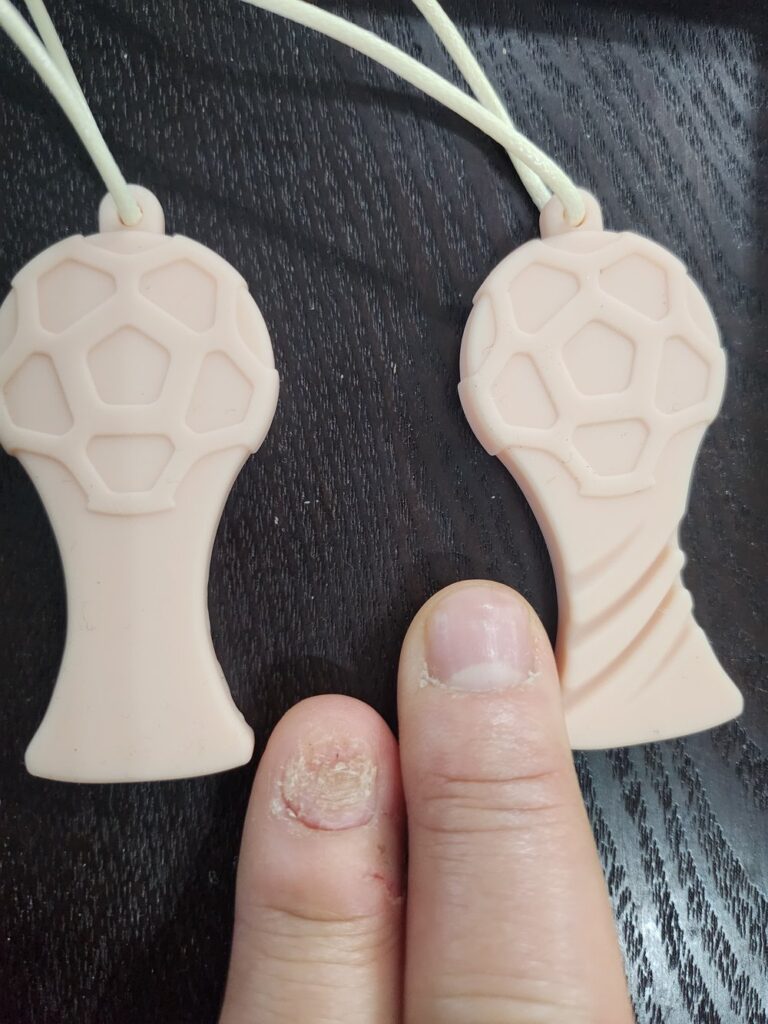
1. Give your mouth and hands a better job. The single biggest change for me was replacing the behavior instead of forbidding it. A chewable necklace (“chewy”) or chew tool gives your mouth the same oral input without wrecking your fingers. Discreet adult versions exist now.
2. Keep a fidget within reach of your dominant hand. Boredom-biting drops a lot when my hands already have something to do — a textured fidget, a ring fidget, a pop tube on the desk.
3. Make the nails physically harder to bite. A short, filed manicure or a bitter anti-bite coating breaks the autopilot — the taste interrupts the loop long enough for me to notice.
4. Build in an awareness cue. I keep my nails painted a color I like; catching that color in my peripheral vision is often what snaps me out of it. Some people use a hair tie on the wrist or a sticker on the laptop as the same kind of pattern-interrupt.
5. Treat the trigger, not just the nails. If I’m biting from stress, the real fix is a two-minute reset — stand up, breathe, change rooms — not white-knuckling my hand away from my mouth.
Affiliate disclosure: This post may contain affiliate links. If you buy through them, I may earn a small commission at no extra cost to you. I only link to tools I actually use or would use myself.
ADHD nail biting: can you ever really stop?
Maybe not completely — and that’s okay. I still bite my nails sometimes — usually when life gets loud. But I’ve stopped treating it as a character flaw and started treating it as information: when the biting spikes, it’s my brain telling me I’m either bored or overloaded. That reframe did more than any single product. It turned a source of shame into a signal I can actually respond to.
If you’re a chronic biter too, you’re not weak and you’re not alone. You have an ADHD brain doing what it does — and you can give it better tools.
Do you bite your nails, pick, or fidget? What’s the one thing that’s helped you most? Tell me in the comments — I read every one.
This article shares personal experience and general information; it isn’t medical advice. Body-focused repetitive behaviors can sometimes need professional support — if yours cause pain, infection, or real distress, please talk to a doctor or therapist.

Grace is a registered nurse with thirteen years of clinical experience — five in Australia and eight in Korea — who also lives with ADHD. She writes The ADHD Nurse: honest, first-person guides and diaries about working, parenting, and getting through the day with an ADHD brain. Everything here is her personal experience and general information, not medical advice.