I spent a month researching ADHD storage bins without buying a single one — and this week, I finally placed the order.
That wasn’t procrastination. That was the whole strategy. My living room has been running on three free Starbucks boxes — remotes, makeup, paperwork. Ugly, and working, which is more than I can say for every beautiful organizer I bought before I understood why my piles form. But cardboard has a lifespan: the corners have gone soft from daily use, and the system has proven itself. So the boxes retire with honors — and the upgrades are on a delivery truck as I type.
Here’s my direct answer, up front: don’t buy ADHD storage bins until a free-box version of the same system has survived in your home for a few weeks. Then upgrade only what’s proven, using three rules: no lids, clear or open-top, and labels. Below: what I ordered, the label maker I picked, and my do-not-buy list. Prices change; check the listing.
When Should You Actually Buy ADHD Storage Bins?
Short answer: after your system has proven itself with containers you already own — and not one day before.
Buying the organizer first is the classic ADHD trap — the same wiring as my impulsive spending: the purchase feels like progress, so the dopamine arrives at checkout instead of at the organizing, and the beautiful bin ends up empty on the pile it was supposed to solve.
The pull toward “just buy something” is real — in a study of just under 1,400 U.S. and Canadian adults, clutter had a strong negative impact on people’s sense of home and well-being (Roster, Ferrari & Jurkat, 2016, Journal of Environmental Psychology). But buying a lifeboat only helps if you’ve learned to float. That’s what the free-box system taught me: the boxes cost $0, so a flopped category could be reassigned guilt-free. The boxes were the experiment; the purchase is the reward, after the data comes in. Mine came in: three weeks, zero abandoned categories, an ending made of worn cardboard, not a shopping urge. (Full honesty: the two posts go live days apart, but three real weeks passed between them — family season jammed my publishing queue.)
Are Clear Bins Good for ADHD?
For most of us, yes — because with ADHD, what you can’t see functionally stops existing. It’s not “object permanence” — it’s working memory. A closed drawer doesn’t just hide your stuff; it deletes the reminder.
ADHD-specialist professional organizer Susan Pinsky builds her whole method on this. As she puts it in Organizing Solutions for People with ADHD (3rd ed., 2023), “efficiency should always take precedence over beauty” — every extra step is another chance to lose the thread.
“Efficiency should always take precedence over beauty.” — Susan C. Pinsky, Organizing Solutions for People with ADHD
The stakes aren’t aesthetic, either — they’re physiological. In a study of 60 dual-income spouses, those who described their own homes as “cluttered” or full of unfinished projects showed flatter daily cortisol slopes — the less-healthy stress-hormone pattern (Saxbe & Repetti, 2010, Personality and Social Psychology Bulletin). I’m not buying decor; I’m buying my hormones a quieter room.
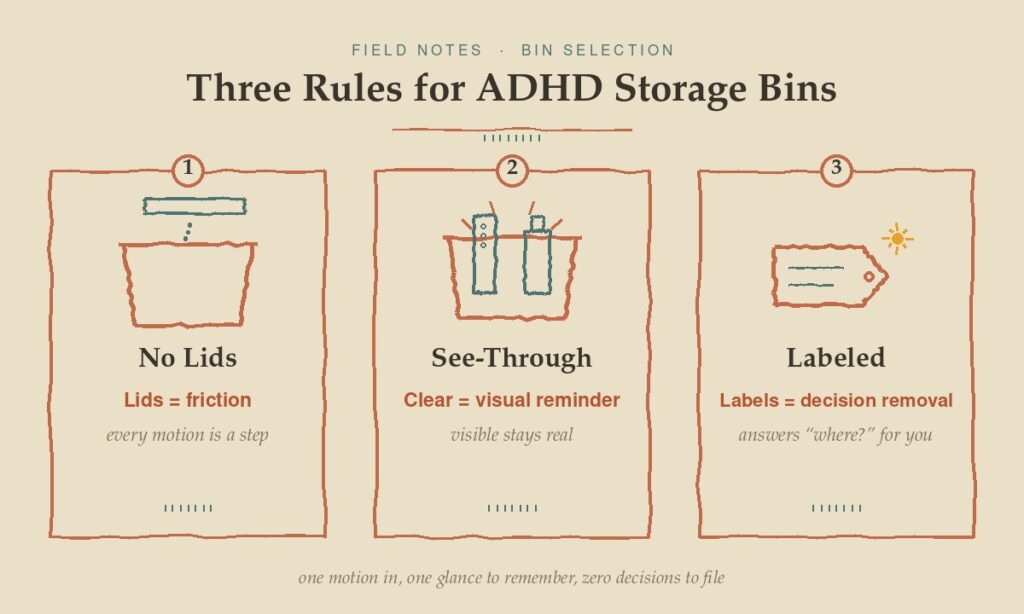
Her one-step principle gives me the three rules I ran every purchase through:
- Lids = friction. Every open-and-close motion is a step, and every step is a place the system dies.
- Clear or open-top = visual reminder. The contents have to stay visible, or they stop being real.
- Labels = decision removal. “Where does this go?” costs executive function; a label answers it before I’m tired enough to ask.
One honest nurse’s caveat: full visibility isn’t free — objects in view compete in the visual cortex, each suppressing the others’ neural response (McMains & Kastner, 2011, Journal of Neuroscience, PubMed). Everything on display is its own kind of noise; a labeled clear bin is the compromise — one designated visible zone. If visual clutter overwhelms you more than out-of-sight forgetting does, closed storage may suit you better; pick the failure mode you can live with.
Which ADHD Storage Bins Did I Actually Order?
Two kinds of acrylic — both clear, both lidless, one per proven category, and nothing more. Just replacements for boxes that earned them.
The workhorse: one multipurpose acrylic clear storage bin. It takes over from the most worn of the three boxes — the everyday catch-all. Clear on every side, open on top, so the one-motion toss survives the upgrade. It arrives today; the photo below is the actual bin in its actual spot, not a render.
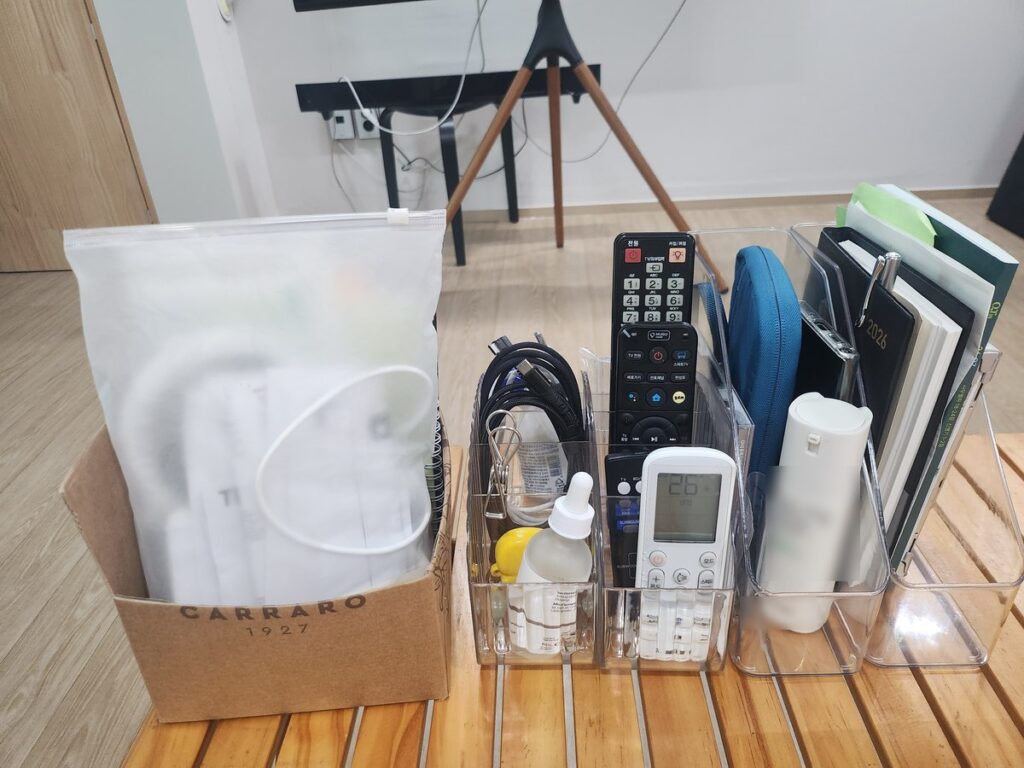
The specialists: two acrylic clear remote-control organizers. One does what the label says — remotes, upright, visible, grab-and-go. The second is my favorite trick: a “remote caddy” is really just a clear bin with tall, narrow compartments — a perfect home for basic skincare, the small bottles from the makeup box. Same category, same address, better housing.
What did not get upgraded: the paperwork box. Paper is the doom pile’s favorite food, and I want more weeks of data before any tray system earns a cent — Pinsky’s paper advice from her CHADD webinar is blunter anyway: most of it, you can simply get rid of. Two boxes graduated; one is still sitting the exam.
Is a Label Maker Worth It for ADHD?
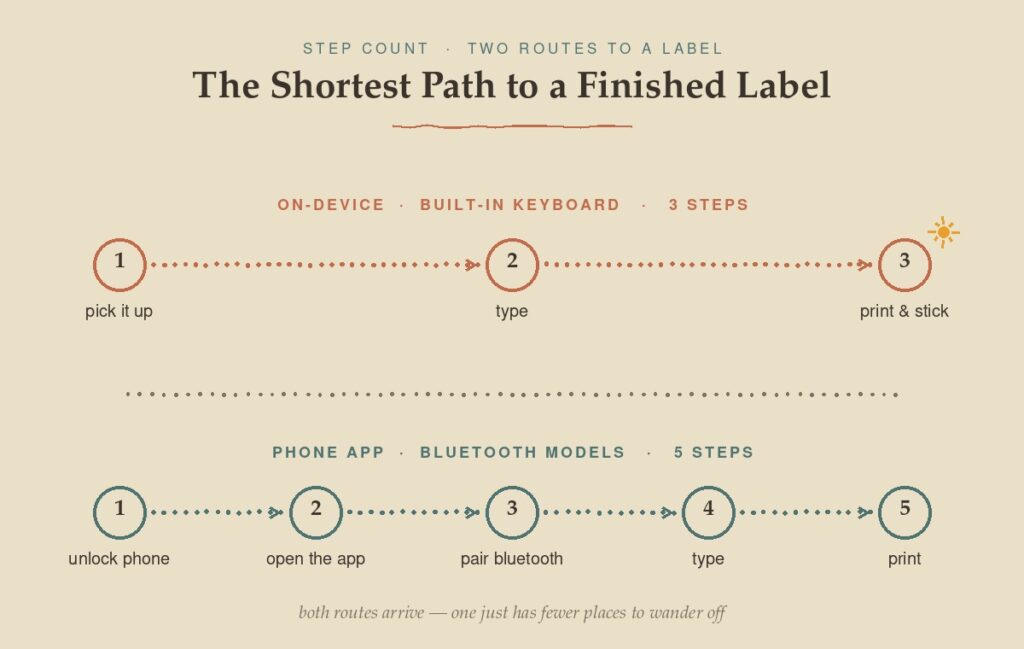
Yes — and after comparing four, I ordered the Brother P-touch PT-N10, the only one on my list with zero Bluetooth. That’s not a missing feature. That’s the feature.
My logic is the same logic this whole blog runs on: every step you remove from a task raises the odds it actually happens. With the PT-N10, labeling is one object and one motion — pick it up, type on the built-in keyboard, print, stick. No unlocking my phone, no app to open, no pairing handshake, no notification ambush that ends twenty minutes deep in email. The tapes come in 17 colors of Brother’s 12mm Btag, so the color-coding urge gets fed, app-free — for an ADHD brain, fewer steps beats more features almost every time. One caveat: Btag tapes only — you’re married to Brother’s refills.
The three I compared and passed on — each good, just not for my brain:
- Niimbot D110 (around $30): prints from a phone app, with genuinely lovely pastel tapes and fonts. Fun matters for a dopamine-driven brain — but “open app, connect Bluetooth” is two extra steps before a finished label.
- Phomemo D30 (around $29): also app-based, with one nice touch — a battery display readable at a glance. Same phone-app chain, though.
- Brother PT-P710BT (around $115): connects to a computer and prints barcodes, QR codes, and shapes exactly as laid out on screen. If you run a physical shop — shelves, price tags, inventory — it’s the one I’d recommend. No storefront here, so it stayed in someone else’s more retail-shaped cart.
Whichever you pick, the label’s job stays the same: be readable by exhausted you. “Meds & chargers” beats “miscellaneous essentials” every time. The machine makes the word durable and — fine, Susan — a little beautiful; choosing it is still my job.
What ADHD Storage Should You Not Buy?
Anything that adds steps, hides contents, or asks you to become a different person. My do-not-buy list, unchanged:
- Opaque bins with lids. Two rules broken at once — where objects go to leave the known universe.
- Clear bins with lids — the sneaky one. Transparency does not cancel friction. Fine for seasonal storage; a slow-motion failure for anything you touch weekly.
- Complicated multi-tier systems. Nine-drawer rolling carts, modular sub-dividers. Every tier is a decision, and decisions are the budget you’re protecting.
- Matching aesthetic sets bought before the system exists. The showroom fantasy in a cart. Find a free box first — your future self still gets pretty bins, earned.
The pattern in all four: they’re storage for the person you’re promising to become, not the person doing the putting-away at 11 p.m. after a shift. Buy for her. She’s the one holding the remote.
Tonight the Starbucks boxes hand over their addresses to acrylic, and I get to say the sentence I waited a month to earn: the system came first, and the card came second. A product post where the products had to pass probation — but that probation is why I trust what’s on the truck.
Your turn: what’s the organizer you bought that never got used — and what free container quietly outperformed it? Tell me in the comments; my retiring makeup box would love the company.
This is my personal experience, not medical advice. Storage bins are support tools, not treatment — if clutter and executive function struggles are seriously affecting your life, an ADHD-informed clinician can help. See my full Medical Disclaimer.

Grace is a registered nurse with thirteen years of clinical experience — five in Australia and eight in Korea — who also lives with ADHD. She writes The ADHD Nurse: honest, first-person guides and diaries about working, parenting, and getting through the day with an ADHD brain. Everything here is her personal experience and general information, not medical advice.