In Diary #6 I finally cleared this desk — a visual timer counting down, a body double keeping me honest — and this entry is about the doom pile organization system that has kept it from burying itself again. Because clearing was never my real problem; for me a clean desk was always a temporary weather condition between piles, and I’ve written before about why my desk kept turning into a doom pile in the first place. So here’s the short answer to how it finally stopped. I didn’t buy a single pretty organizer. I beat my pile in three moves: I started with a timer and a body double instead of willpower (that part was #6’s story), I gave every object a visible “address” using free Starbucks drink carriers and packaging boxes, and I added one small maintenance device — a checklist board — so the system survives my brain on its worst days.
That’s it. No container-store haul, no minimalism conversion, no personality transplant.
I want to be honest: I am not a professional organizer. I’m a registered nurse with ADHD whose desk used to look like a paper landslide with a stuffed animal on top. (Exhibit A: the left half of that photo.) What I can offer is what actually held up in my house — and why, because the why matters more than the boxes.
What Is Doom Pile Organization (and Why Isn’t It Just “Cleaning Up”)?
Doom pile organization means giving every object in the pile a permanent, visible home — an address it can return to — instead of just making the pile disappear once. Cleaning is an event. An address system is infrastructure. My old routine was the event version: every few weeks I’d sweep the whole desk into a bag, feel like a new person for three days, and then watch the pile rebuild itself, envelope by envelope.
The pile isn’t just ugly, either — it’s load-bearing on your mood. Mine sat at the edge of my vision all evening, humming one low note — you should be dealing with me — and by the end of the day I could feel that hum in my shoulders. My pile wasn’t sitting there passively. It was transmitting.
So the goal of doom pile organization isn’t a showroom. It’s a desk where, when I put something down, there is exactly one obvious place for it to land — and that place is not “on top of everything else.”
Why Doesn’t Normal Storage Advice Work for an ADHD Brain?
Because normal storage advice assumes that once a thing is put away, you’ll remember it exists. My brain does not sign that contract. For a lot of us with ADHD, out of sight becomes out of mind — a drawer might as well be a portal to another dimension. I have “organized” things into drawers and then repurchased them, twice, because the drawer version stopped existing the moment it closed.
And here’s the part that took me years to accept: I always knew how to organize. Knowing was never the problem. As Dr. Russell Barkley writes in Taking Charge of Adult ADHD, “ADHD is a disorder of performance—of doing what you know rather than knowing what to do.”
“ADHD is a disorder of performance—of doing what you know rather than knowing what to do.” — Russell A. Barkley, PhD, Taking Charge of Adult ADHD
Every drawer-and-label system I ever built was a knowledge solution to a performance problem. It asked my brain to remember invisible things and execute multi-step put-aways — the exact two functions my wiring rations out on good days only. Not laziness — a mismatched tool. The fix wasn’t trying harder with closed storage. It was switching to storage my brain can see.
How Do You Start Organizing a Doom Pile When You Can’t Start?
You don’t start with the pile. You start with a timer and a witness. The single session that broke my pile’s back was the one I told you about in Diary #6: timer running where I could see it, a body double keeping me company, and permission to stop when the timer stopped. Mine happened to be an AI co-working session — my body double lives in a chat window — but a friend on speakerphone works just as well.
The timer matters because “sort the whole desk” is a task with no edges, and my brain refuses tasks with no edges. “Sort until the timer ends” has edges. The body double matters because starting is the broken step, not sorting — once my hands were moving with someone (or something) present, the sorting itself was almost boring.
One session. Not a weekend overhaul. The pile was maybe 70% processed when the timer ended, and I let that be fine.
What Do Free Starbucks Boxes Have to Do With Organization?
Everything, apparently. While sorting, I kept making little piles-within-the-pile — electronics here, hair clips there — and I realized the categories needed somewhere to live or they’d re-merge by Friday. I had no organizers. I did have a Starbucks drink carrier and a couple of their sturdy packaging boxes waiting for the recycling bin.
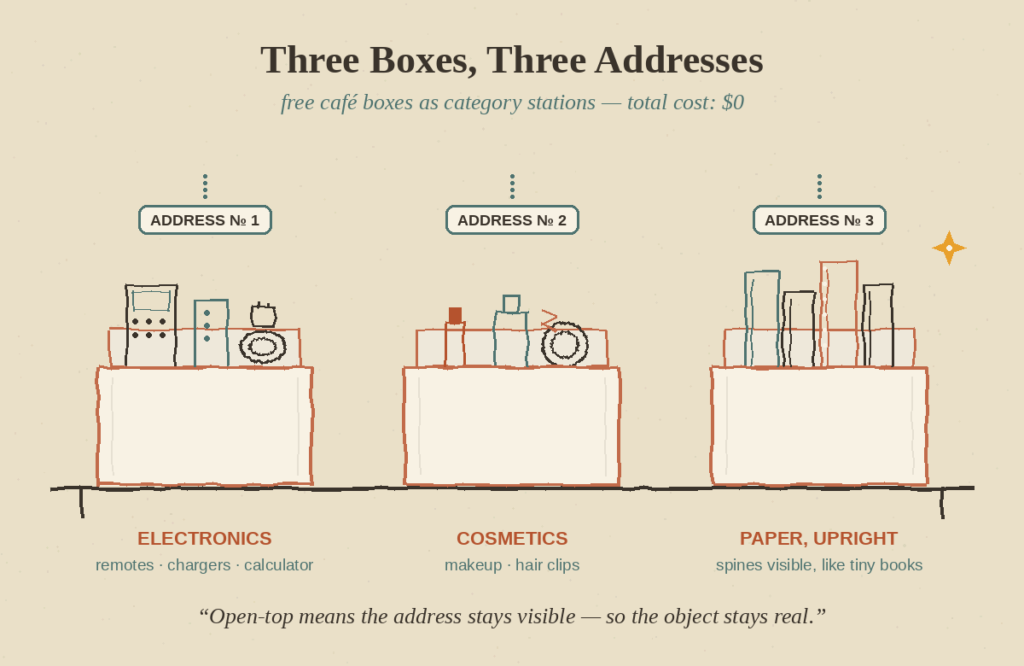
So now my desk has three stations, total cost zero dollars:
- The electronics box — remotes, chargers, the calculator that used to migrate around the desk like a nomad.
- The cosmetics box — makeup, hair clips, the small things that used to dissolve into the pile.
- The paper box — notebooks, my Rocketbook, and documents standing upright, spines visible, like tiny books.
Notice what these have in common: they’re all open-top. I can see every item without opening anything. That’s not an aesthetic choice — it’s the entire mechanism. Open boxes turn “put it away” from a memory-plus-effort task into a one-second drop. The address is visible, so the object stays real.
And there’s a sneaky bonus to the boxes being free and slightly shabby: they killed my perfectionism excuse. I used to postpone organizing until I could buy the right matching containers — which meant never. You can’t precious-ify a Starbucks box. You just use it.
How Do You Keep a Doom Pile From Coming Back?
With a device, not a resolution. Resolutions are me promising my future self will be a different person; she never is. So the maintenance layer on my desk is deliberately dumb and visible: a yellow To Do board with sliding tabs I flick over when something’s done, a small whiteboard for the week, and a mini alarm clock for time checks.
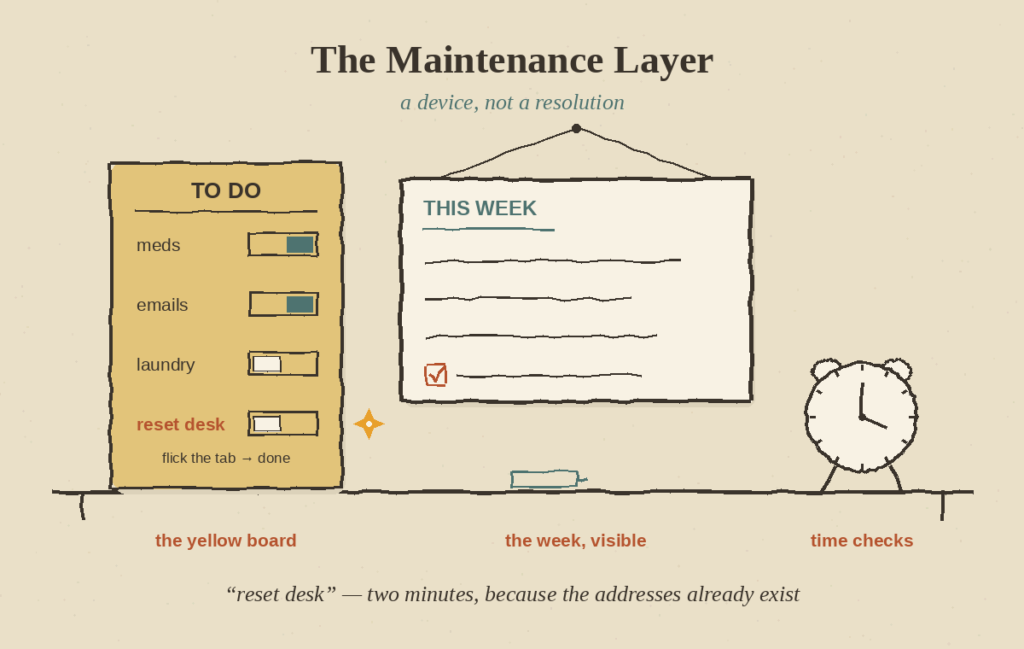
One line on that board just says reset desk — a two-minute pass where everything on the surface goes back to its address. Two minutes, because the addresses already exist. That’s the whole trick: maintenance is only hard when items have nowhere to go.
Does Doom Pile Organization Ever Become Fun?
Weirdly — yes, and nobody is more surprised than me. Somewhere in the last few weeks, tidying started paying out tiny hits of dopamine, one drop at a time. I reset the desk, look at the three boxes sitting there smug and correct, and feel a little ping of reward. Then the loop kicked in: once one zone was organized, the un-organized zones started to visually itch — the shelf next to the desk, the chair that collects clothes. I caught myself wanting to give those an address too. If you have ADHD, you know how rare that sentence is: momentum, showing up uninvited.
There’s a second root to that itch, and it comes with actual paperwork. When I went through my ADHD assessment, the results came back with more than I’d walked in for: my doctor told me there’s a drop of autism in the mix, too. A drop is honestly how it feels — not a flood, just enough to tint the water. (The community has a word for this combo — AuDHD — and the longer I live with it, the better it fits.) In me, that drop shows up like this: when something sits outside the frame or breaks the rule, my brain quietly refuses to look away. For years it worked against me — the pile broke every rule, so I stopped looking. But now clean and in its place is becoming the frame — and the wiring that used to fuel my avoidance has switched sides. When a charger lies outside its box, it nags me until I walk it home. My own diagnosis, hired as maintenance staff.
My desk still gets messy. Papers still land on it, because I still live here. The difference is that mess now has somewhere to drain to — the pile can’t compound anymore. My standard is no longer “perfectly organized.” It’s “every object has an address, and tonight they all went home.” Some weeks that’s the only thing in my house I’m proud of, and I’ve decided that counts. This page of the diary has its address now too — filed right after #6, where it belongs.
What’s sitting in your doom pile right now — and if you gave it an address today, what would the box be? Tell me in the comments. Bonus points if your organizer is garbage-adjacent.
This is my personal experience, not medical advice. If clutter, executive dysfunction, or hoarding-level accumulation is seriously affecting your life, an ADHD-informed clinician can help you far more than a Starbucks box can. See my full Medical Disclaimer.

Grace is a registered nurse with thirteen years of clinical experience — five in Australia and eight in Korea — who also lives with ADHD. She writes The ADHD Nurse: honest, first-person guides and diaries about working, parenting, and getting through the day with an ADHD brain. Everything here is her personal experience and general information, not medical advice.