A few months ago I wrote about building a dopamine menu for my ADHD brain — and this follow-up is the receipt: the actual dopamine menu items on my slow, nurse-vetted shopping list. Because here’s the thing nobody warns you about: once you’ve built the menu, you start wanting to stock the pantry.
These aren’t gadgets that promise to “fix” my attention — they’re small, cheap, mostly boring objects that make it easier to change my state on purpose, plus one surprise from my own drawer. No affiliate links, no “buy now.” Just what earns a spot, and where the evidence is thin. Prices are approximate.
What dopamine menu items are actually worth buying?
The short answer: the best dopamine menu items give you a fast, low-effort sensory cue — a small switch that tells your brain “we’re changing modes now” — plus one or two that get your body moving without a whole gym. And sometimes the best one isn’t a purchase at all.
That maps onto the menu courses: appetizers (instant hits) become roll-on oils and a pocket fidget; sides become a diffuser humming beside admin, or a resistance band under the desk; mains are movement; and desserts turned out to be the course I’d already paid for. None of it is a treatment — it’s a toolbox for a brain that runs low on stimulation.
Do essential oils actually help ADHD focus?
Honest answer, nurse hat on: scent is not a treatment for ADHD, and the evidence for it is weak. The UK’s NICE guideline (NG87) doesn’t recommend aromatherapy for ADHD; first-line care is behavioral support and, where appropriate, medication.
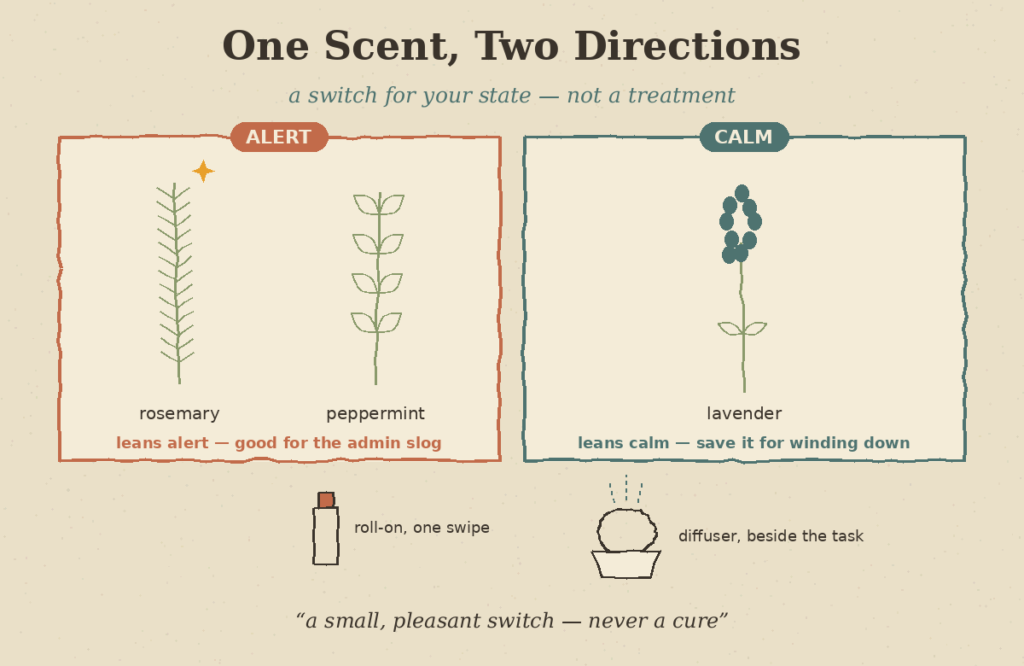
What scent can do is act as a small, pleasant sensory switch — with modest research on smells nudging alertness in healthy adults. Rosemary aroma has been linked to better memory quality and accuracy, plus a lift in subjective alertness (Moss et al., 2003, International Journal of Neuroscience); peppermint, to increased alertness (Moss et al., 2008). Lavender did the opposite in that 2003 study — impairing working memory and slowing reaction times. (To be fair, rosemary was no magic focus button: it sharpened accuracy while actually slowing raw speed — a nudge, not a switch-flip.)
- Rosemary and peppermint lean alert — a good “sides” cue for admin slogs.
- Lavender leans calm — lovely for winding down, wrong pick for focus.
Caution: viral claims that vetiver oil treats ADHD trace back to a small, unpublished 2001 case study — never peer-reviewed, never reliably replicated. A hopeful anecdote, not proof.
As CHADD writes in its aromatherapy explainer, “there is no scientific evidence they produce positive measurable outcomes consistently across a given population” (CHADD, “Smells Good to Me: What about Aromatherapy?”). So I buy scent the way I’d buy a nice candle — for the small pleasure and the mode-switch, not the cure.
“Although many essential oils smell nice, there is no scientific evidence they produce positive measurable outcomes consistently across a given population.”— CHADD (Children and Adults with ADHD)
What’s roughly on my aroma list (approximate prices):
- A starter oil set, about $10–25 — rosemary and peppermint included; “therapeutic grade” is unregulated, so don’t pay extra for it.
- An ultrasonic diffuser, about $15–40 — reviewers keep naming the ASAKUKI 500ml a quiet value pick.
- A roll-on blend, about $8–15 — my true appetizer: a swipe on the wrists, a breath, back to work. (Patch-test first.)
One safety note I can’t skip (nurse rule)
If you live with pets, be careful: cats lack an essential liver enzyme for metabolizing these compounds and are especially sensitive to phenols, so the more concentrated the oil, the greater the risk (Pet Poison Helpline). Concentrated oil should never touch a cat’s fur or be swallowed, dogs included — and even a passive diffuser can cause respiratory irritation. So diffuse only in ventilated rooms your animals can’t enter, keep bottles well out of licking range, and ask your midwife or doctor first if you’re pregnant or nursing. A pleasant smell is never worth a sick pet.
Does exercise help ADHD like medication?
This is where the evidence gets much stronger. Movement genuinely helps ADHD symptoms, and it appears to work partly through the same door as stimulant medication: by raising dopamine and norepinephrine, the very neurotransmitters those meds target.
A network meta-analysis drawing on a systematic review of 59 studies (1,757 participants analyzed) found physical exercise significantly improved executive function and eased inattention and hyperactivity in kids and teens with ADHD (Ren et al., 2023, Frontiers in Public Health). The authors put it plainly: “by boosting dopamine and norepinephrine neurotransmitters, physical exercise may act physiologically similarly to stimulant drugs for alleviating the symptoms of ADHD.”
My wrinkle: mid-rehab from shoulder surgery, upper-body loading is out — so I went looking for low-impact, lower-body movement that sits beside a boring task.
What’s the quietest exercise equipment for a small apartment?
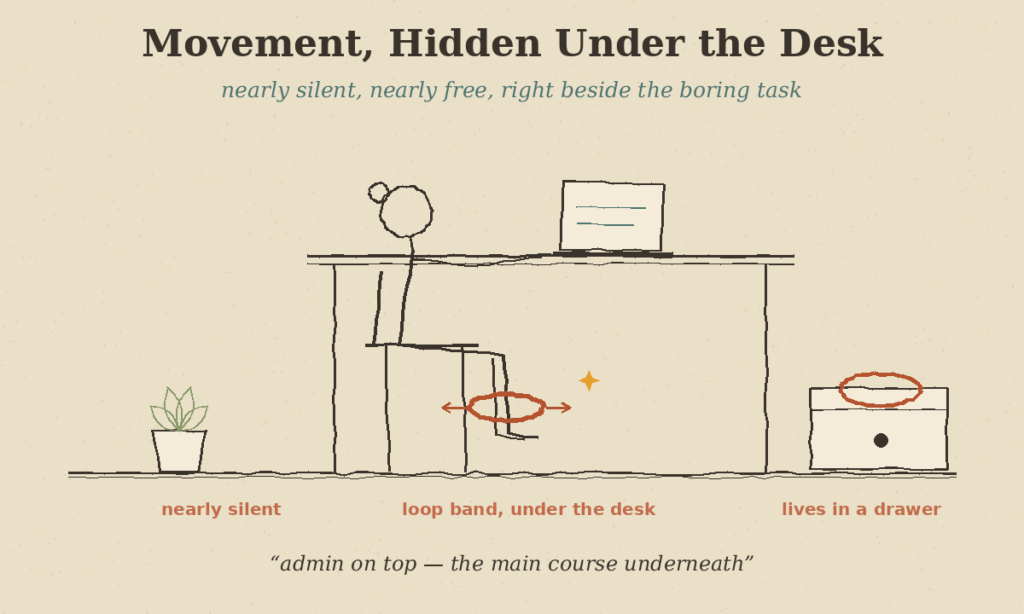
Direct answer: resistance bands are the quietest dopamine menu items for movement — and the smallest, which turned out to be the criterion that decided my list.
- Resistance bands (about $10–30). Nearly silent, tiny, cheap, and gentle on my shoulder rehab. My one movement pick: a loop band under my desk, working my lower body while I sit and do admin. Lowest barrier to entry; lives in a drawer when done.
- Under-desk pedal / elliptical (about $40–200). Cubii-style ellipticals are near-silent; the DeskCycle is sturdy but a bit more audible. A good upgrade later — the band earns its keep first.
- Mini trampoline (rebounder) (about $40–120). Confession: this was almost my headline pick. On paper it was perfect — I’m on the ground floor, so noise wasn’t the issue, and a gentle bounce sounded like joy. Then I did the thing my ADHD brain hates most: before buying, I measured the floor. Verdict: even folded, it would claim more space than it earned. So I let it go, a little sadly. If you have real floor space, it’s a joyful low-impact option — just use a mat if anyone lives below.
What about fidgets and coloring?
Quick, because I already live here. A quiet fidget cube (about $8–15) gives my hands something to click during calls. Adult coloring with gel pens (book $8–14, pens $10–20) sits between a main and a dessert: absorbing enough to quiet the noise, light enough to feel like a treat. Neither “treats” ADHD; they keep restless hands busy while the rest of me settles. (My 5-minute visual timer session pairs well with coloring.)
Can a dopamine menu item be something you already own?
Yes — and mine might be the best thing on this list, because it cost me exactly nothing.
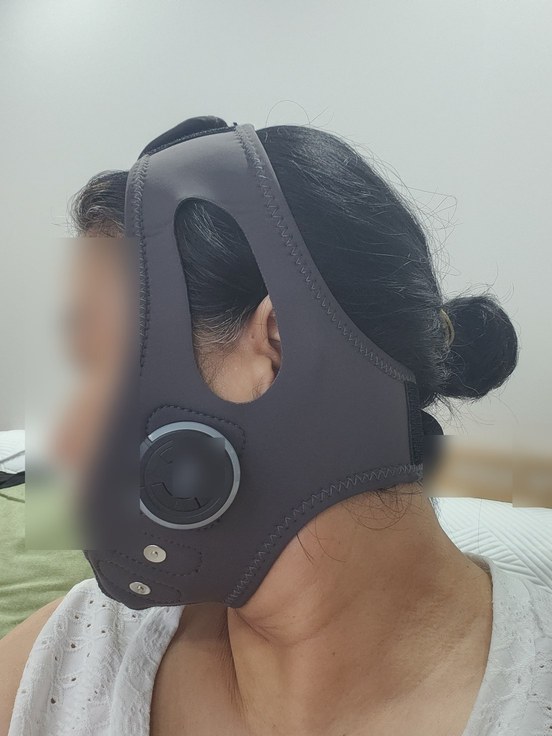
Buried in a drawer, I had a facial contour massage band — one of those microcurrent/EMS-style bands you strap around your jawline. Bought in an optimistic moment ages ago, never used since — the most ADHD sentence I’ll write today: the buying delivered the dopamine, and the owning never got a turn. While making this list, I went shopping in my own drawers first — and put it on the menu.
Nurse hat, briefly: I’m making zero claims about what it does for my face. It earned its slot because for ten minutes my hands are occupied and my phone isn’t — a forced mini-break — and because it’s a small sensory ritual: snug pressure, a quiet hum, sitting still by appointment. On my menu it lives between an appetizer and a dessert.
And yes, a beauty gadget is an odd item for an ADHD toolbox. But a dopamine menu is personal by design. If the thing that buys your brain ten quiet minutes is a skincare band from the back of a drawer, it belongs on your menu as much as a resistance band belongs on mine.
How do I keep dopamine menu shopping from becoming impulse spending?
I have to say this part out loud, because it’s my own weak spot. A shopping list of “dopamine menu items” can quietly turn into a scroll through a shopping app at 11 p.m. — not on my menu; a trigger. I’ve written before about my ADHD and impulsive spending, and the irony of a shopping post is not lost on me.
So I treat this as a slow, deliberate list, not a haul. The trampoline is Exhibit A that the system can work: I wanted it, the reasons all sounded good, and the tape measure still got a vote before my card did. The massage band is Exhibit B: the most satisfying “new” item this month came out of my own drawer, not an app. Check your drawers before your cart — some of the best dopamine menu items are ones you’ve already paid for.
If I had to hand someone a starter three, it’d be a resistance band, one alert-leaning roll-on (rosemary or peppermint), and a quiet fidget. About $30 total, all evidence-honest, all easy to actually use. Small things, chosen on purpose, are the whole point of a dopamine menu — a plate of little wins for a brain that struggles to reach for the big ones.
What’s on your list — and what’s already hiding in your drawers? Tell me in the comments.
This is my personal experience as someone with ADHD, not medical advice. Aromatherapy is not a treatment for ADHD, and exercise supports symptoms but doesn’t replace care — talk to an ADHD-informed clinician about what’s right for you. See our Medical Disclaimer.

Grace is a registered nurse with thirteen years of clinical experience — five in Australia and eight in Korea — who also lives with ADHD. She writes The ADHD Nurse: honest, first-person guides and diaries about working, parenting, and getting through the day with an ADHD brain. Everything here is her personal experience and general information, not medical advice.