A dopamine menu is a pre-made list of pleasurable, healthy activities — sorted like a restaurant menu — that you can pick from when your ADHD brain is running low and begging for stimulation. The idea is simple: instead of defaulting to a doom scroll at 9 p.m., you glance at your menu and “order” something that actually leaves you feeling better.
I’ll be honest up front: I haven’t built mine yet. This isn’t a “here’s how I fixed it” post. It’s a “here’s a tool I just discovered and I’m about to try it” post — and I wanted to think it through out loud first. If it works, I’ll come back and tell you exactly how it went.
What is a dopamine menu — and why does the ADHD brain crave one?
The term “dopamine menu” (or “dopamenu”) was popularized by Jessica McCabe of How to ADHD and ADHD coach Eric Tivers, and it’s caught on for a reason: it’s built around how our brains actually work (Melanie Wolkoff Wachsman, “Using a Dopamine Menu to Stimulate Your ADHD Brain,” ADDitude, updated June 16, 2026).
Here’s the wiring underneath it. People with ADHD show reduced dopamine activity in the brain’s reward pathway — the accumbens and midbrain regions that handle motivation and pleasure (Volkow et al., 2009, JAMA). Dopamine is the “this is worth doing” chemical, and when there’s less of it on tap, a boring-but-important task feels almost physically impossible to start, while anything shiny and instant feels irresistible. So we reach for the fastest hit available — usually the phone.
The trouble is those fast hits don’t fill the tank. As McCabe puts it, the problem isn’t that we’re lazy or wasting time on purpose:
“Most of us don’t spend hours scrolling through social media because we think it’s a good use of our time; we do it because we are looking for the stimulation we need to function.” — Jessica McCabe, 2024
A dopamine menu is the fix for that: a ready-made list of better sources of stimulation, prepared in advance for the exact moment you’re too depleted to think of them yourself.
Why does a menu beat a to-do list?
Because it separates the planning from the choosing — and for an ADHD brain, those are two very different jobs.
When I’m already low on dopamine, asking me to sit down and figure out “what would make me feel better right now, that’s also good for me?” is asking a lot. I have to generate the options, weigh them, work out the steps, and then start — all while bored and depleted. That’s the exact state where my brain says forget it and grabs the phone. It’s the same wall I hit with task paralysis: the deciding is the hard part, not the doing.
A menu does the hard thinking ahead of time, on a day when I actually had the bandwidth. By the time I need it, there’s no deciding left — just ordering. That’s the whole trick.
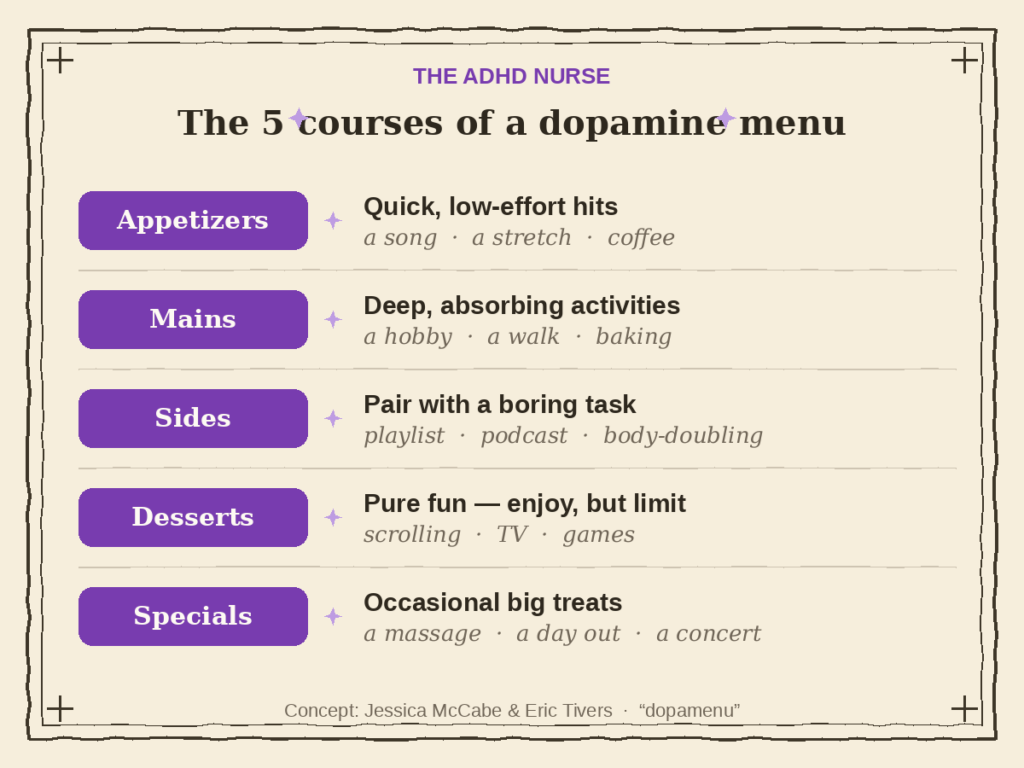
How I’m building my own dopamine menu
McCabe’s format uses courses, like a real menu. Here’s how I’m planning to fill mine out — and I’m sharing my actual drafts so you can see it’s not fancy.
Appetizers — quick, low-effort hits that don’t suck me in. A worship song. A cup of coffee made slowly. Stepping onto the balcony for two minutes. One round of my shoulder-rehab stretches. A thirty-second prayer.
Mains — the engaging stuff that genuinely lights me up. Hunting for new products to source for my resale shop (my brain will happily hyperfocus on this for an hour). Writing a post with my AI partner. A brisk walk. Baking something.
Sides — things I run alongside a boring task to make it bearable. An upbeat playlist while I pack orders. A podcast during admin. Body-doubling — working “next to” someone, even on a video call.
Desserts — pure fun, fine in small amounts, easy to overdo. A reality show. YouTube. The trick, McCabe says, isn’t to ban dessert; it’s to notice when dessert is all you’re ordering.
Specials — occasional, bucket-filling treats that take planning. A proper massage for my shoulder. A café afternoon with a good coffee. A day trip.
One honest note: a dopamine menu isn’t a to-do list, a cure for ADHD, or a replacement for medication or therapy. It’s just a stimulation cheat sheet — and that’s exactly why I want to try it.
What “junk food” am I keeping off the menu?
This is the part I most need. Some activities hand you a hit of dopamine and then a hangover of regret — and those don’t get a spot on the menu at all.
For me that’s the late-night phone scroll (my own revenge bedtime procrastination special) and, more dangerously, scrolling shopping apps — which is how my impulsive spending starts. Those go on a separate “not on the menu” list, and McCabe’s advice is to build in friction: charger away from the bed, shopping app deleted from the phone, so the junk food takes more steps to reach and the good stuff takes fewer.
So that’s the plan. This week I’m going to actually build the thing — write it out, make it pretty, and stick it where I’ll see it. Then I’ll live with it for a while and report back in a follow-up post: what I actually ordered, what I never touched, and whether it kept me off the 9 p.m. scroll. If you’ve been curious about a dopamine menu too, maybe build yours alongside me.
P.S. For all this talk of menus, the biggest dopamine hit — hands down — is family. I live on my own most of the time, but the week my son comes to visit, I turn into someone so busy and productive I hardly recognize myself. Turns out my favorite “main course” was never on the menu at all.
Have you made a dopamine menu? I’d love to steal your best “main course” — tell me in the comments.
This is my personal experience and general information, not medical advice. A dopamine menu is a self-help tool, not a treatment — if low motivation or loss of interest in things you used to enjoy is weighing on you, that can be a sign of depression, and it’s worth talking to a doctor.

Grace is a registered nurse with thirteen years of clinical experience — five in Australia and eight in Korea — who also lives with ADHD. She writes The ADHD Nurse: honest, first-person guides and diaries about working, parenting, and getting through the day with an ADHD brain. Everything here is her personal experience and general information, not medical advice.