Is maladaptive daydreaming a symptom of ADHD?
No. Maladaptive daydreaming (MD) is not a defining symptom of ADHD, and it is not on any official ADHD checklist. You can have ADHD without ever experiencing MD, and you can have MD without having ADHD at all.
But the overlap is striking, and this is where the numbers get misread — so let me be careful about direction, because the two figures point opposite ways:
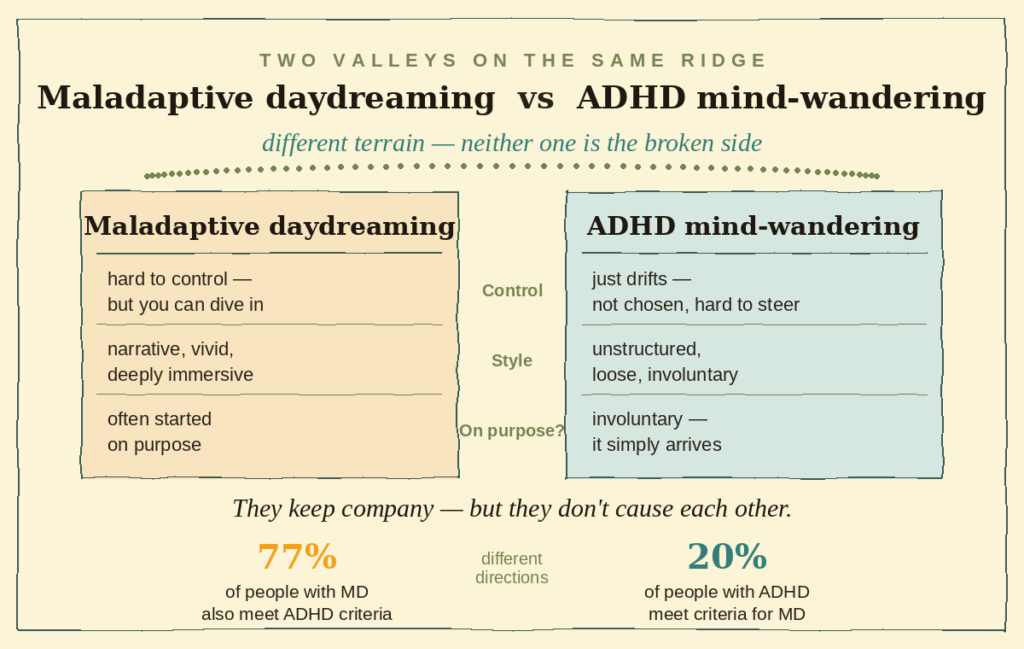
- Among people who have maladaptive daydreaming, almost 77% also meet criteria for ADHD — in that clinical sample, ADHD was the single most common co-occurring condition, ahead of anxiety and depression (Somer et al., 2017, Journal of Nervous and Mental Disease)
- Among people who have ADHD, about 20% meet the criteria for MD (Theodor-Katz et al., 2022, Journal of Clinical Psychology)
Those aren’t the same statistic, and the difference matters. MD very often comes packaged with ADHD; ADHD only sometimes comes packaged with MD. They tangle — they don’t cause each other: two real patterns that like to keep company.
What is maladaptive daydreaming?
Here’s the nuance that matters. Maladaptive daydreaming is a proposed condition — first named by clinical psychologist Eli Somer — describing vivid, immersive, hours-long fantasy that you struggle to control and that starts to crowd out real life. It is not a core feature of ADHD. What the research does show is high co-occurrence: in one clinical study of people with MD, ADHD was the most common co-occurring condition — mostly the inattentive type.
Maladaptive daydreaming is extensive, immersive fantasy that starts to replace real-life functioning rather than enrich it. Eli Somer defined it as “extensive fantasy activity that replaces human interaction and/or interferes with academic, interpersonal, or vocational functioning“ (Eli Somer, “Maladaptive Daydreaming: A Qualitative Inquiry,” Journal of Contemporary Psychotherapy, 2002). The word doing the heavy lifting is maladaptive — daydreaming itself is human and healthy; this is the version that takes over.
“Extensive fantasy activity that replaces human interaction and/or interferes with academic, interpersonal, or vocational functioning.”
— Eli Somer, Journal of Contemporary Psychotherapy (2002)
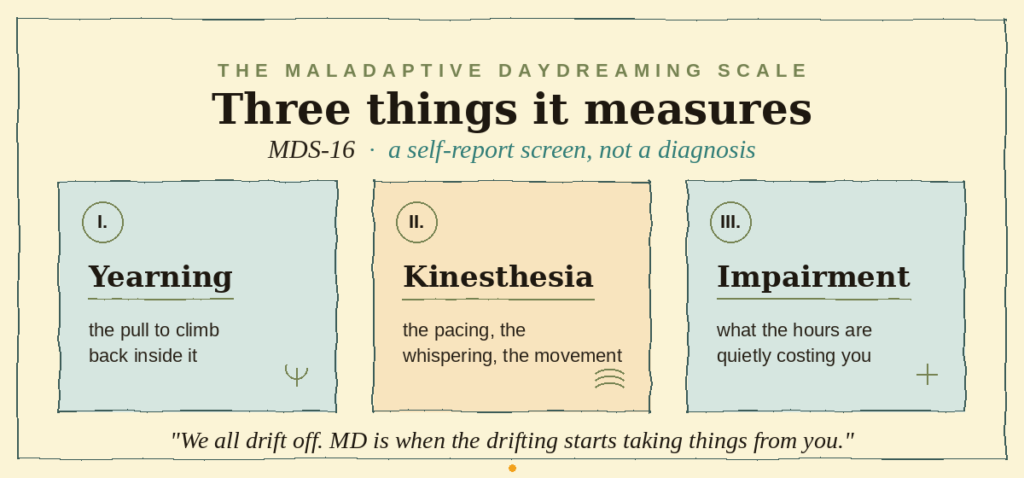
There’s also a screening tool, the Maladaptive Daydreaming Scale (MDS-16), a 16-item self-report with a suggested cutoff around 40. It measures three things that made me sit up the first time I read them: yearning (the pull to get back in), kinesthesia (the pacing and movement that come with it), and impairment (what it’s costing you).
That last word is the line. We all drift off. MD is when the drifting starts taking things from you.
Why do ADHD and maladaptive daydreaming overlap so much?
They overlap because they share some of the same machinery — and because, for a lot of us, daydreaming becomes a way to cope.
On the wiring side, both involve difficulty with attention regulation and executive function, plus a brain that goes looking for stimulation when the outside world isn’t providing it — the same restless, under-stimulated pull I write about in ADHD and attention dysregulation. Except instead of bouncing between tabs, the attention turns inward and builds a world.
But there’s a difference researchers are careful to name. ADHD mind-wandering tends to be unstructured and involuntary — your attention just drifts. MD is something else: narrative, emotionally vivid, deeply immersive, and often started on purpose. It’s less “I lost my train of thought” and more “I left the station.”
And this is the part I most want to be honest about. Somer described MD as serving two functions: disengagement from stress and pain, and wish-fulfillment. In plain terms — avoidance. When emotions get too big, daydreaming becomes somewhere to go instead of somewhere to feel, the same escape route I describe in ADHD and emotional dysregulation. My daydreams almost always switched on at the exact moments real life got hard.
When I got scolded by my parents or had an argument with my boyfriend, in my head I was having a date with a superstar.
And here is the trap nobody warns you about: the more I escaped, the less real life could satisfy me. The daydream was always better — better cast, better dialogue, better me. So coming back got harder, reality felt flatter, and the only relief was to leave again. That’s the loop. It isn’t weakness — it’s an avoidance pattern doing exactly what it was built to do.
Maladaptive daydreaming vs normal daydreaming — what’s the difference?
The difference comes down to three things: control, immersion, and cost. Normal daydreaming is something you do; maladaptive daydreaming is something that does you.
Ordinary daydreaming is brief, controllable, and harmless — you wander off planning dinner, then come back. Maladaptive daydreaming is hard to control and pulls you in for hours, often deepened by evocative music and kinesthetic stereotypies — the pacing, whispering, and small repetitive movements that come with being that absorbed.
The real dividing line is impairment plus distress. Normal daydreaming costs you nothing. MD starts quietly billing you — the missed work, the conversations you weren’t really in, the hours you can’t get back.
How do I know if my daydreaming is a problem — and what helps?
You’ll usually know by the cost, not the content. The warning signs are: you can’t easily stop, you struggle to come back, real life feels less satisfying than the fantasy, and there’s a layer of shame around how much time it’s taking.
If that’s landing a little too accurately, please hear what I wish someone had said to me sooner. You are not crazy. When my own daydreams wouldn’t stop, I genuinely thought I was losing my mind — and I’ve since learned how many people quietly carry that exact fear. You are not broken, and you are not alone.
What turned it around for me wasn’t willpower. It was understanding — finding the research, hearing a friend describe the very same thing, realizing this had a name and a mechanism. What I’d hidden as my own private failing turned out to be documented — named, measured, studied for decades. My secret was just research I hadn’t read yet. That reframe — from “something is wrong with me” to “a studied coping pattern my brain learned” — loosened its grip.
A few honest, practical notes. The MDS-16 exists as a self-screening tool — it can show you where you land, but it is not a diagnosis. Because MD so often sits on top of emotional regulation, avoidance, and sometimes trauma, the most useful move isn’t to white-knuckle the daydreaming away — it’s to get curious about what you’re escaping from. And if it’s interfering with your life, an ADHD-informed clinician can genuinely help.
You’re not losing your mind
You are not broken, and you are definitely not “crazy.” You’re most likely dealing with a coping pattern your brain built to protect you — one that researchers have studied and named, and one that often keeps ADHD company. That’s not a verdict. It’s a starting point.
I still daydream. I just don’t disappear into it the way I used to, because now I can usually tell when I’m reaching for it to avoid something real — and that awareness, it turns out, is most of the work.
So I’ll ask you the question I once couldn’t answer for myself: Do your daydreams ever feel like somewhere you go to escape — and is it getting harder to come back? I’d really love to hear your story in the comments.
This is my personal experience as a nurse and someone with ADHD. It is for information and support only — not a diagnosis or medical advice. Maladaptive daydreaming is a proposed condition still being researched. If daydreaming is interfering with your life, please talk to a qualified mental health professional.

Grace is a registered nurse with thirteen years of clinical experience — five in Australia and eight in Korea — who also lives with ADHD. She writes The ADHD Nurse: honest, first-person guides and diaries about working, parenting, and getting through the day with an ADHD brain. Everything here is her personal experience and general information, not medical advice.