Within a month of my diagnosis, I had collected more ADHD medication myths than prescriptions. They came from people who love me, which is what made them sting. “You know taking it doesn’t cure it, right?” “I heard it dulls your thinking.” “Once you start, you’re on it for life.”
Here’s the short version, up front: most of these are half-truths with the wrong conclusion attached. ADHD medication doesn’t cure ADHD — neither do glasses cure nearsightedness, and nobody calls glasses pointless. The “zombie” feeling is usually a dosing signal, not the medication’s personality. Lifelong use isn’t an automatic sentence; it’s a decision you and your prescriber revisit, ideally every year. And the addiction fear? Large studies point in a direction most people don’t expect.
I’ve been a ward nurse in Australia and Korea for 13 years. I spent most of those years teaching patients how to take their medications — and then I became the patient, diagnosed with ADHD as an adult and now taking methylphenidate myself. So when the myths started arriving, I did what nurses do. I looked things up.
A quick note before we start: this is my personal experience plus published research, not medical advice. Every medication decision belongs with you and your prescriber.
Why do ADHD medication myths hurt more than they sound?
Because they don’t stay words — they turn into decisions. A myth sounds like small talk, but it lands on someone who is already unsure, already a little ashamed of needing a pill to do what everyone else seems to do for free. And people who are unsure delay treatment, skip doses, or quietly stop.
That’s not a guess. In an analysis of 1,229,972 people across nine countries and regions, including the US, 61% of young adults aged 18 to 24 stopped their ADHD medication within the first year (Brikell et al., 2024, The Lancet Psychiatry). Hold that number — we’ll come back to it, because it flips the most popular myth on its head.
First, let me fact-check the ones I actually heard.
Does ADHD medication cure ADHD?
No — and that’s not the gotcha people think it is.
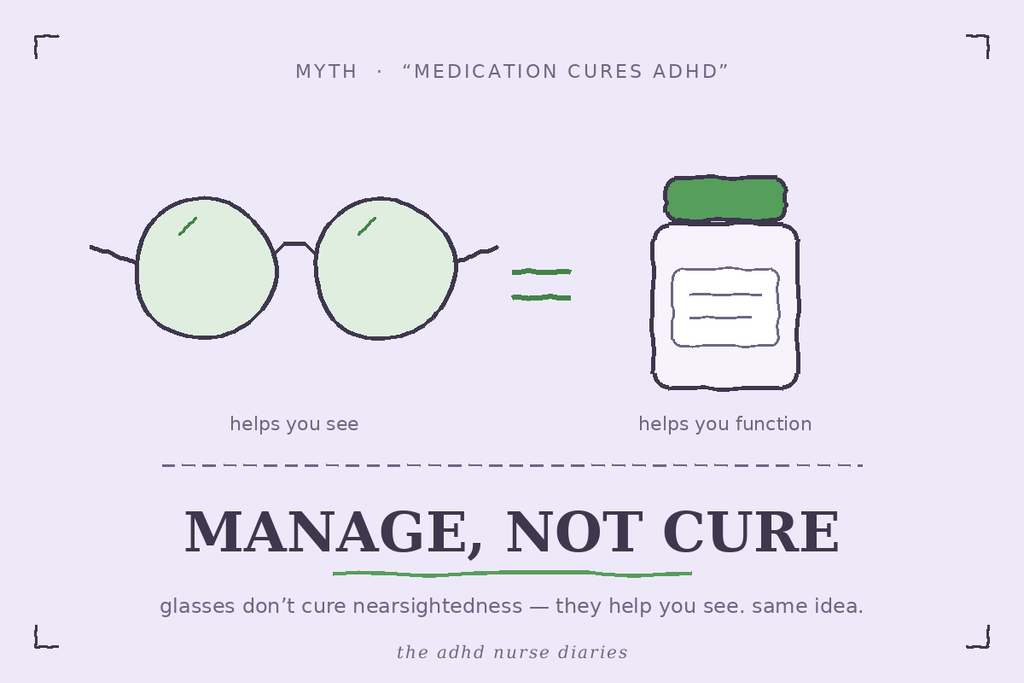
“It doesn’t even cure it” was the first thing said to me, delivered like a checkmate. And the premise is true: stimulant medication manages symptoms while it’s working. It doesn’t rewire the diagnosis away. But by that logic, my glasses are a scam, and so is every blood pressure tablet on my medication cart. We don’t ask most medicine to cure. We ask it to let us function while it’s on board — to focus a blurry mind the way lenses focus a blurry eye.
The evidence that stimulants work while you take them is about as solid as evidence gets in psychiatry — large meta-analyses of double-blind trials consistently rank them among the most effective treatments in the field. What the research doesn’t promise is that a pill alone transforms a life. Long-term follow-up studies suggest medication’s head start narrows over the years if nothing else changes. That nuance matters, and I’ll tell you further down what I think fills the gap — because it’s the part of this story I’ve lived.
Does ADHD medication turn you into a zombie?
The flat, dulled, “where did my personality go” feeling is real — but it’s not the medication working as intended. It’s usually a sign the dose or the timing is wrong.
This myth frustrates the nurse in me more than any other, because it takes a report-this-to-your-prescriber signal and repackages it as a quit-immediately verdict. In patient education, we call the adjustment period titration: start low, observe, adjust. Feeling foggy or emotionally flattened is data. The usual responses are a lower dose, a different schedule, or a different medication — not abandoning treatment in week two.
And here’s the reframe I wish someone had handed me earlier: at the right dose, the medication doesn’t erase who you are. For many of us it does the opposite — the person who was always there finally gets some airtime, without forty tabs open in her head. Not sedation — subtraction of static.
Do you have to take ADHD medication forever?
No. Continuing, reducing, or stopping is a decision that gets reviewed, not a life sentence that gets served.
Clinical guidelines in several countries — including the UK’s national guidance — recommend that ADHD medication be reviewed at least once a year, with trial periods of reducing or stopping actively considered. That is the opposite of “once you start, you can never stop.” It’s closer to a lease with an annual renewal meeting.
Two honest caveats, because half-truths are how myths are born. First, some people do benefit from taking medication long term — that’s not failure, any more than long-term glasses are failure. Second, stopping abruptly on your own is where symptoms tend to come roaring back; the same guideline evidence notes measurable worsening within weeks of unplanned discontinuation. The question was never forever or not. The question is who decides, and how often — and the answer is you and your prescriber, on a schedule, on purpose.
Is ADHD medication addictive?
This is the fear underneath most of the others, so let’s give it the most data.
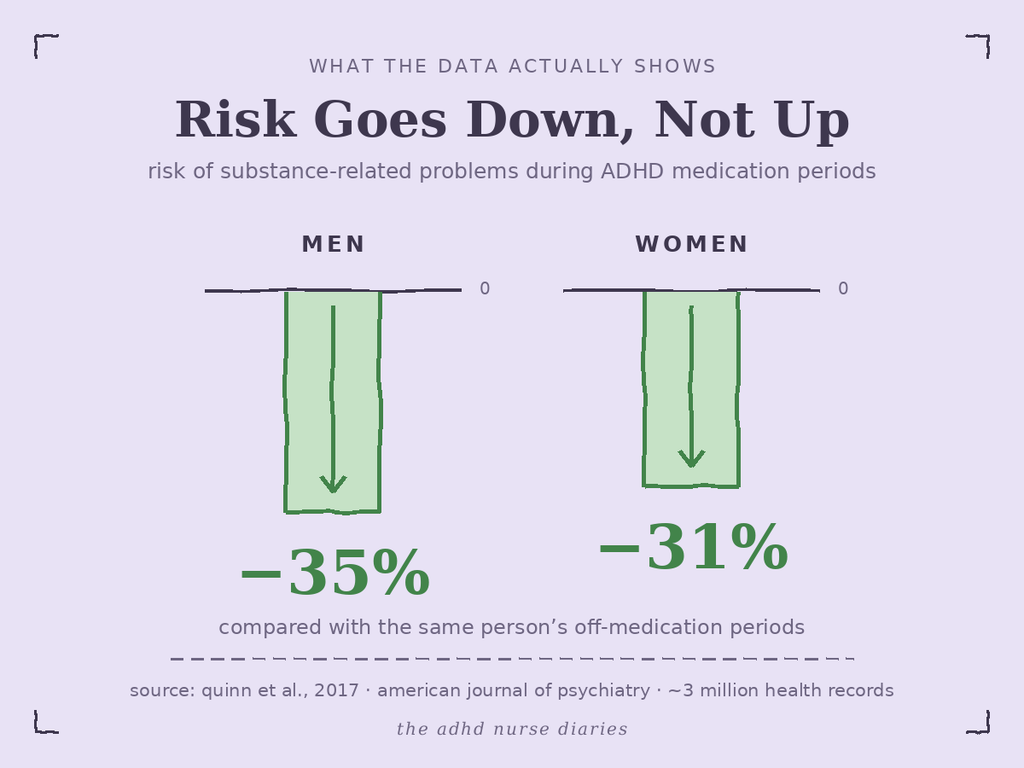
When taken as prescribed, the large studies we have are reassuring — and one of them points somewhere genuinely unexpected. In a study of health records from roughly three million Americans, the risk of substance-related problems was 35% lower for men and 31% lower for women during the periods they were taking ADHD medication, compared with periods they weren’t (Quinn et al., 2017, American Journal of Psychiatry). As lead researcher Patrick D. Quinn of Indiana University put it, “While concerns about prescribing medications to treat ADHD that have the potential for abuse are understandable, this study provides further evidence that the use of these medications is not associated with increased risk of substance use problems in adolescence or adulthood” (“ADHD medication tied to lower risk for alcohol, drug abuse in teens and adults,” News at IU, July 13, 2017).
“While concerns about prescribing medications to treat ADHD that have the potential for abuse are understandable, this study provides further evidence that the use of these medications is not associated with increased risk of substance use problems in adolescence or adulthood.”
— Patrick D. Quinn, Indiana University (2017)
I want to be careful here, because careful is the whole point of this post. Not every study finds a protective effect — a meta-analysis of earlier, smaller studies found no significant relationship in either direction. So the honest summary is this: there is no good evidence that prescribed ADHD medication raises addiction risk, and the largest studies suggest it may lower it. “It’s basically a drug habit” is not a conclusion the data supports. Misuse — someone else’s pills, someone else’s dose — is a different story entirely, and it’s exactly why these medications are prescribed and monitored the way they are.
Is ADHD medication a hormone?
This one may sound strange to some readers, but it reached my ears more than once after my diagnosis — a rumor circulating where I live that ADHD medication is “a hormone drug,” with everything scary that implies.
For the record: methylphenidate is not a hormone and has nothing to do with hormone therapy. It’s a central nervous system stimulant — it works in the brain’s signaling, affecting dopamine and norepinephrine, which is a completely different mechanism from any hormonal medication. I include this myth not because it’s in the English-language literature (I couldn’t find it there) but because myths are local creatures. Whatever the rumor in your corner of the world sounds like, the pattern is the same: a scary-sounding category, attached to a medication the speaker has never looked up.
What actually makes ADHD medication work? A nurse’s honest answer
Here’s the irony that made me want to write this post. Everyone around me worried I’d be on medication forever. The data shows the real-world problem is the opposite: most people quit too soon.
Remember that number from the top — 61% of young adults stopping within the first year (Brikell et al., 2024)? Discontinuation was most common at exactly the age when people are first managing their own treatment. And after 13 years of medication counseling at the bedside, I can tell you the unglamorous truth about most medications: adherence is where treatment lives or dies. A medication can only do its job if the right amount is in your system, consistently. On-again, off-again dosing means you never actually find out what the treatment can do — you just collect side effects on the on-days and symptoms on the off-days, then conclude it “didn’t work.”
With ADHD there’s a crueler twist, one I now live instead of lecture about: the condition itself sabotages the treatment. Forgetting things and struggling to hold routines are core symptoms — and taking a pill at the same time every day is a routine. The illness attacks its own cure. I spent 13 years teaching patients to take their medications on schedule, and in my first weeks of treatment I still found myself at 10 p.m. staring at the pill pouches, genuinely unsure about that morning. I wasn’t a bad patient. I was a textbook one.
So my nurse’s answer to “does it work?” is: partly, that’s up to the system you build around it. Alarms, a visual timer, pill pouches by the kettle — somewhere my eyes land every single day. Unsexy scaffolding, doing heavy lifting.
Can medication actually change your habits? What happened to me
Let me end with the part no study can confirm for me, offered exactly as what it is: one person’s experience.
The conventional wisdom about change runs mind-first: fix your thinking, and behavior follows. For me it ran backwards. The medication didn’t change my thoughts — it made new behavior possible. Suddenly the boring, load-bearing actions I’d failed at for decades were simply… available. Starting the task at nine instead of panicking at midnight. Finishing a workday without the wheels coming off. Doing the dish now.
And then time did something patient and quiet: repeated behavior became habit. Months of days stacked into routines that now hold some of their own weight — the way managing your own dopamine slowly stops being a project and starts being a default. Behavior first, then habit, then — it genuinely feels like — a new groove in the brain. I want to be honest: I know of no study that has directly tested that exact sequence, and I’m not claiming my experience is proof. What the research does support is that medication combined with behavioral work tends to outperform either alone. The way I’ve come to say it: the medication was never the building. It was the scaffolding that let me build.
So no, a pill didn’t cure me. It lent me a functioning starter motor, and I drove somewhere with it.
If you’ve heard your own version of these myths — from family, from the internet, from the voice in your own head — I’d love to hear the worst one in the comments. Naming them out loud is half the fact-check.
This post describes my personal experience alongside published research. It is not medical advice, and it is not a recommendation to start, stop, or change any medication. Those decisions belong with you and your prescriber — please talk to them about anything you’ve read here.
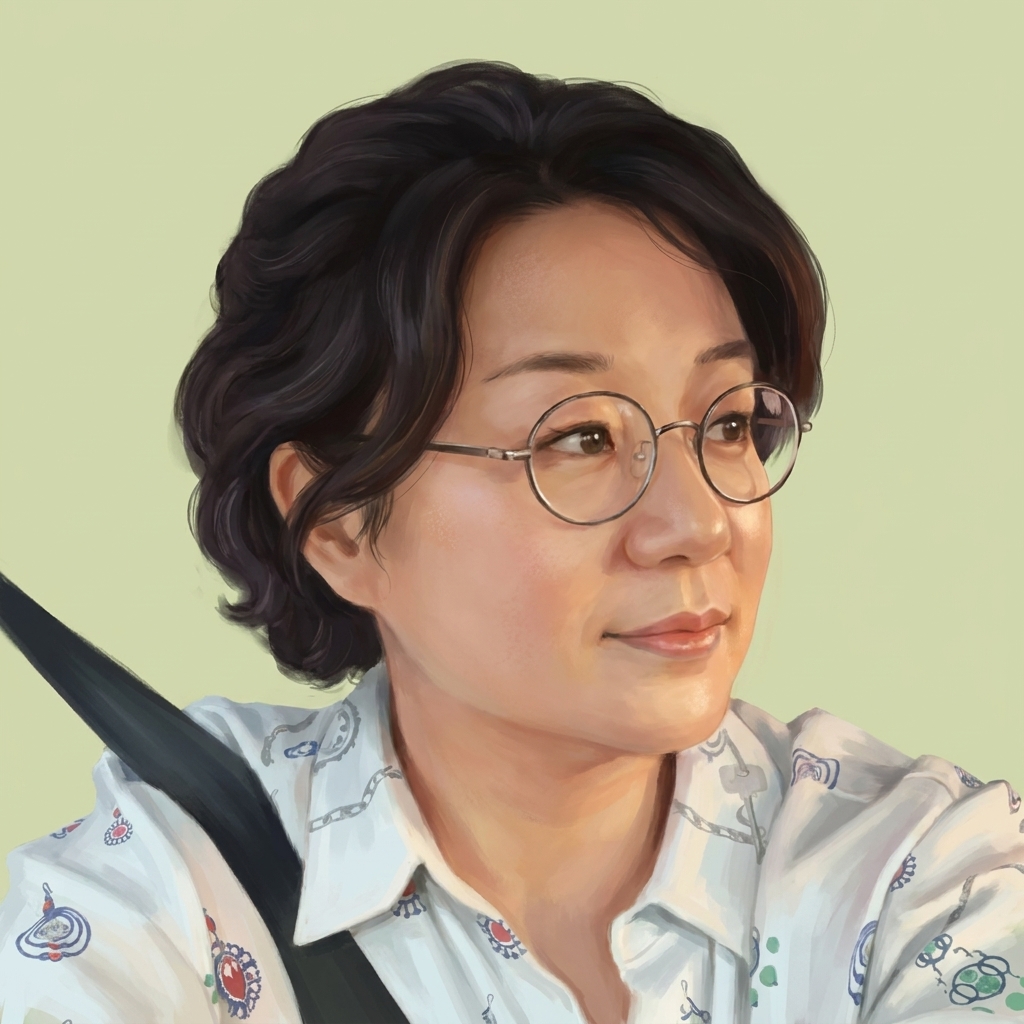
Grace is a registered nurse with thirteen years of clinical experience — five in Australia and eight in Korea — who also lives with ADHD. She writes The ADHD Nurse: honest, first-person guides and diaries about working, parenting, and getting through the day with an ADHD brain. Everything here is her personal experience and general information, not medical advice.