ADHD task paralysis has a long track record with me: the vacation homework I never started, the book reports I never wrote, the diary that stayed blank all summer.
Every break, it was the same. The assignments sat on my desk, and I sat next to them — not doing them, not not worrying about them, just frozen in between. Then the night before school started, the panic would finally outweigh the freeze, and I’d scramble through the whole pile at once. I always told myself the same thing: I just have to write one. One line. Why can’t I write one line?
For most of my life I read that as a character flaw — proof that I was lazy, or that I was the kind of person who’s just bad at real life. I wasn’t. It has a name, and it isn’t laziness. It’s ADHD task paralysis — and the strangest part of my story is that the girl who couldn’t finish a single book report now writes a diary entry almost every day. Here.
What is ADHD task paralysis, really?
It’s when you really want to do the task, you know how to do it, you even care about it — and you still cannot make yourself begin.
That’s the part outsiders miss. ADHD task paralysis isn’t about ability or desire; it’s a failure at the starting line. The Cleveland Clinic describes it as feeling so overwhelmed that you can’t initiate or finish, even when you want to (The Cleveland Clinic, “Feeling Stuck? Here’s How To Overcome ADHD Paralysis,” Cleveland Clinic, October 9, 2023). Your body stalls at the threshold of a task while your mind spins. From the outside it looks like doing nothing. On the inside, it’s the opposite of nothing — it’s a quiet, exhausting gridlock.
ADHD task paralysis: why can’t I start, even when I want to?
Because for an ADHD brain, the starting line is where three things collide at once: overwhelm, the fear of doing it imperfectly, and a dopamine tank sitting near empty.
ADDA traces it to exactly this mix — feeling swamped, not knowing which piece to grab first, and a reward system that won’t switch on for a task that isn’t interesting yet (ADDA Editorial Team, “ADHD IN REAL LIFE,” ADDA, February 10, 2025) . And there’s a fourth piece I know intimately: the deadline doesn’t feel real. As I wrote about ADHD time blindness, my brain only really registers “now” and “not now,” so the due date stays imaginary until it’s suddenly, brutally now.
Stack those together and “just start” becomes a wall. The bar in my head is set at a hundred — it has to be perfect — while the fuel to clear even an inch sits at zero. I freeze, not because I don’t care, but because some part of me already knows it won’t be perfect, and that gap feels unbearable. (I unpack that bar-at-a-hundred trap in my perfectionist confession.)
Is ADHD task paralysis just laziness — or something real?
It’s real — and it is not laziness.
Here’s the cleanest way I can put it: a lazy person doesn’t want to do the thing. I wanted to, desperately. I lay awake over those unwritten book reports. I’d have given anything to be the kid who just did them. Laziness doesn’t ache like that. ADHD task paralysis is a wiring problem in the brain’s start-up system — executive function and dopamine — not a verdict on your character. And it’s common: executive dysfunction, the brain’s start-and-manage system, affects up to 80–90% of adults with ADHD in their daily lives (Barkley & Murphy, 2011, Journal of Psychopathology and Behavioral Assessment).
And believing the “lazy” story does real damage. Every missed deadline became more evidence that something was wrong with me, and that shame made the next task even scarier to start. The freeze fed the shame; the shame fed the freeze.
From ADHD task paralysis to a daily blog: what changed?
So how does someone who never finished a single book report end up writing almost every day? The honest answer: nothing about my willpower changed. My conditions did.
Three things flipped the switch. Interest — I’m fascinated by this, so my dopamine actually shows up. A smaller bar — I stopped demanding a perfect post and let a rough one count. And a partner: working alongside an AI as a co-writer means I see something take shape instead of staring at a blank page alone.
That’s the whole secret, and it’s almost annoyingly simple. The blank page never beat me because I was weak. It beat me because I kept trying to clear it under the worst possible conditions — alone, uninterested, aiming for perfect. Change the conditions, and the same “lazy” brain writes every day.
How do I break out of ADHD task paralysis? (just one line)
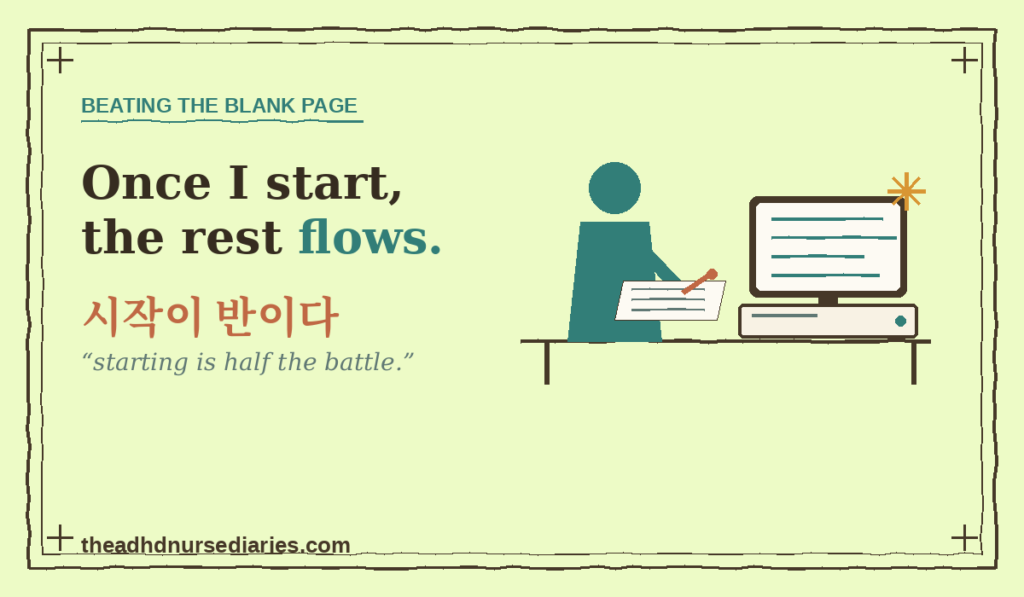
Here’s the honest answer: I stop trying to finish, and I just start — one line, thirty points, and that’s allowed to be enough. That’s not just my trick — it’s what Cleveland Clinic’s Dr. Michael Manos tells people who feel frozen: “The feeling of being stuck is an illusion because there’s always going to be the next action you can take” (Michael Manos, PhD, “Feeling Stuck? Here’s How To Overcome ADHD Paralysis,” Cleveland Clinic, October 9, 2023).
“The feeling of being stuck is an illusion because there’s always going to be the next action you can take” (Michael Manos, PhD, Cleveland Clinic (2023)
And I’ll tell you what’s helped most: AI. When I work alongside an AI partner, I actually see something take shape — and the moment a result appears, the dopamine finally fires. That little hit is what keeps me going, and what makes it stick. It feels like I’m living in a good era, where technology hands a brain like mine the exact scaffolding it was always missing. So if you’re wired like me — copy me shamelessly. Let the tools do what white-knuckle willpower never could.
I’ll also be honest about what doesn’t work for me. The famous “five-minute rule”? Mostly a flop in my hands — setting a timer and promising myself “just five minutes” rarely gets me moving. But aiming for thirty points instead of a hundred — that one works.
There’s a Korean saying I lean on: 시작이 반이다 — “starting is half the battle.” I love it, because it lets me off the hook in exactly the right way. If hitting thirty points counts as having started, then I’m already past fifty. Half done, just for beginning. And honestly? My chest loosens a little. The pressure drains out.
Do you freeze at the starting line too — wanting to do the thing, and still not moving? Tell me the task you keep not-starting in the comments. Then go aim for thirty points on it. That’s already past halfway.
This is my personal experience, not medical advice. “Task paralysis” is a widely used term, not a formal diagnosis. If freezing and avoidance are wearing down your work or your self-worth, an ADHD-informed clinician can genuinely help — naming it was the start of everything changing for me.

Grace is a registered nurse with thirteen years of clinical experience — five in Australia and eight in Korea — who also lives with ADHD. She writes The ADHD Nurse: honest, first-person guides and diaries about working, parenting, and getting through the day with an ADHD brain. Everything here is her personal experience and general information, not medical advice.