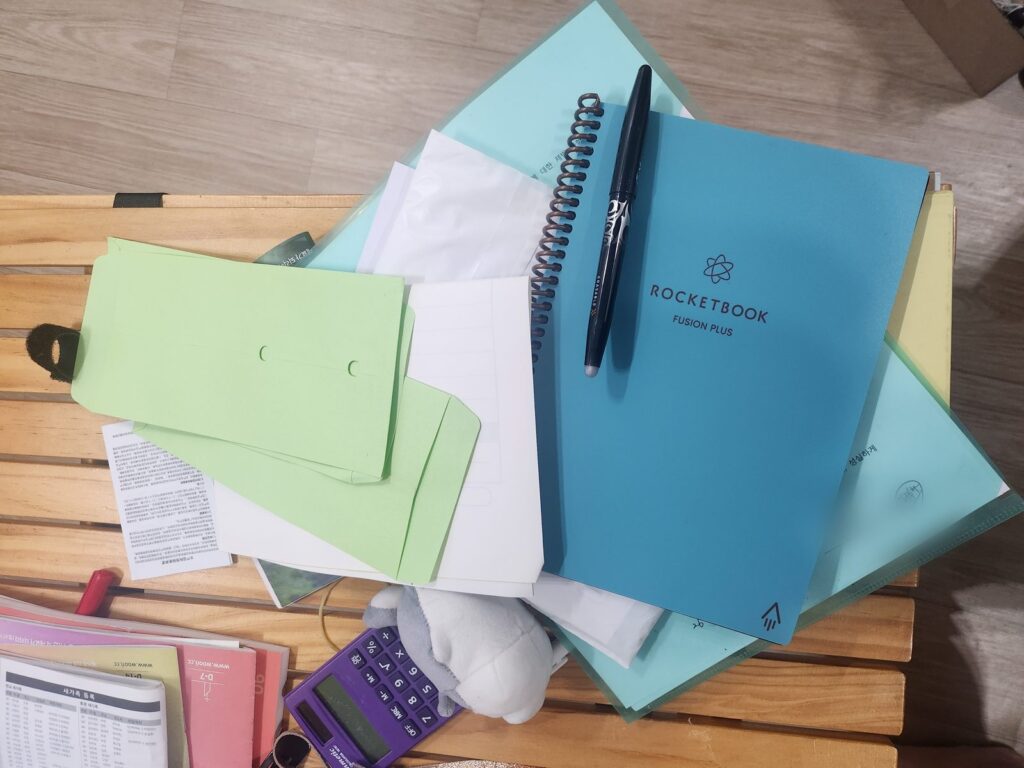
An ADHD doom pile is what’s sitting right next to my computer as I write this — a stack of notebooks, a book, loose papers, and a little colony of things I “have to deal with”: supplements, a snack, the TV remote, and a bottle of dishwasher rinse aid I bought and parked there so I’d remember to reorder it. None of it is trash. All of it is undecided.
If you have one too — on a chair, a kitchen counter, an entryway floor — you’re not messy or lazy. You’ve built an ADHD doom pile, and there’s a real reason your brain makes them. I’m a nurse with ADHD, so here’s both the why and the fix that actually worked for me.
What is an ADHD doom pile?
A doom pile is a heap of unsorted stuff that collects on a surface you pass all day: mail, clothes, chargers, receipts, and “I’ll deal with it later” objects that never get dealt with.
The name says everything. DOOM stands for “Didn’t Organize, Only Moved” (Alexandrea Cantwell,”My Doom Piles Screamed ‘undiagnosed ADHD’,” ADDITUDE, Updated on May 9, 2025) — you cleared a surface, but you never actually decided where anything goes, so it all just relocated into one pile. The term came from ADHD TikTok, not a textbook, which is part of why it spread so fast: thousands of people looked at it and saw their own counter.
Why does the ADHD brain make doom piles?
Because putting one thing away is never just one thing. Every object is a tiny decision — where does this live, is it trash, will I need it later — and an ADHD brain pays full price for each one. Stack thirty items and that’s thirty decisions, and somewhere around the fifth or sixth the executive-function tank runs dry and the brain says, reasonably, absolutely not. So everything gets shoved into a holding pattern instead of decided. It’s the same deciding-overwhelm behind ADHD task paralysis, just with physical objects.
There’s a second wire crossed: out of sight, out of mind. For ADHD that isn’t a missing sense of object permanence — it’s working memory. If I file the rinse aid in a cupboard, I will forget it exists. So I leave it where I can see it. Multiply that by every “don’t forget” item and the pile becomes a kind of external memory, parked in the worst possible spot.
It’s common, and it can get heavy. Research from a UK adult ADHD clinic found that nearly 1 in 5 adults with ADHD (19%) showed clinically significant hoarding symptoms — compared with just 2–3% of adults without ADHD (Morein-Zamir et al., 2022, Journal of Psychiatric Research). As lead researcher Dr. Sharon Morein-Zamir explains, “Hoarding Disorder is much more than simply collecting too many possessions” (Sharon Morein-Zamir, “ADHD Linked to Hoarding Behaviour,” Anglia Ruskin University, 25 February 2022). A doom pile isn’t hoarding — but it sits on the same spectrum of “deciding what to keep is genuinely hard,” which is exactly why it’s worth catching early.
“Hoarding Disorder is much more than simply collecting too many possessions.”
— Dr. Sharon Morein-Zamir, Anglia Ruskin University (2022)
My ADHD doom pile: the desk I actually use
Here’s mine, no staging. Right beside my keyboard: notebooks, a book, papers, vitamins, a snack, the remote, and that bottle of rinse aid waiting to be reordered. Every single item is there for a “good” reason — and the reason is the trap. Each thing earned its spot by being something I didn’t want to forget, and together they buried the desk I need to work on.
How do you clear an ADHD doom pile — and keep it clear?
The strategy that fits my brain is the one experts call “reduce flat surfaces,” but I read it my own way: don’t just clear the pile, give every item a home so it has somewhere to land that isn’t the counter. Environment design beats willpower, because the environment doesn’t get tired and talk you out of it — the same thing I learned fixing my ADHD bedtime procrastination.
My version uses recycled delivery boxes as drawers. I took a tall cabinet — one vertical zone where everything got stacked and lost — and turned it horizontal: open boxes lined up on each shelf like pull-out bins, each one labeled (“IKEA & gloves,” supplements, cables). Now an item doesn’t need a decision, it needs a box. “Where does this logically go?” becomes “which bin do I drop this in?” — a far cheaper question for a tired brain.
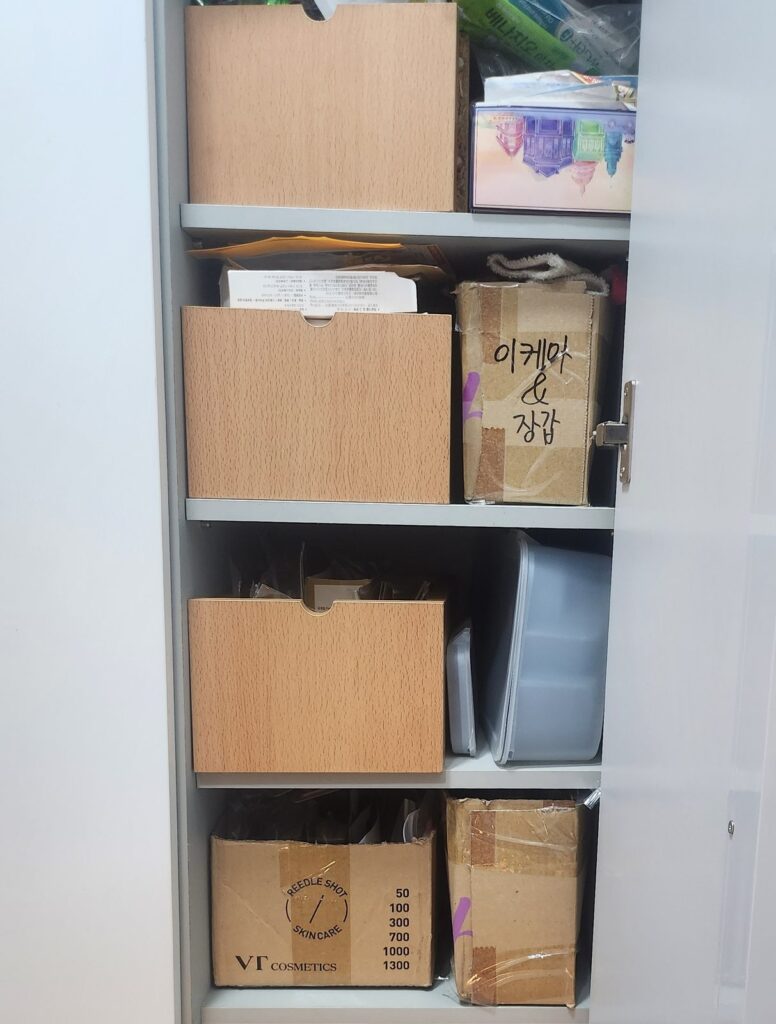
The labeling matters more than it looks. The trick isn’t writing the “correct” category — it’s writing the word the rushed, tired version of me will actually recognize at a glance. “Stuff” is useless; “IKEA & gloves” is instant. A good label removes the decision entirely, which is the whole point: the box does the thinking so my executive function doesn’t have to.
A few more that help: set a 15-minute timer and clear one surface, not the whole room; do it with someone present, since even a quiet body double — or an AI co-worker counts; and aim for “good enough,” not magazine-perfect.
You’ll also hear about the five-minute daily reset — sweep the surface back into its boxes at the same time each day before the pile re-seeds. I have to be honest: this is the one that works least for me. Building a routine like that takes a long time and a lot of trial and error before it actually sticks, so if it doesn’t click right away, you’re not failing — you’re just early. Take what works for your brain and leave the rest.
So here’s the honest part: I just set my boxes up today. A clean desk this afternoon proves nothing — an ADHD doom pile clears for good only when every item has a home, not when you finally try harder, and the only real test is whether it’s still clear next week. So check back. I’ll report whether the recycled-box system actually survives seven days of real ADHD life. The battle continues next week.
What’s on your doom pile right now — and where does it actually live? Tell me in the comments, and let me know if the box trick works for your brain too. And honestly, brag a little: if you’ve found any way to organize that works for your ADHD brain, show it off down there — drop it in the comments and I will absolutely cheer you on.
This is my personal experience and general information, not medical advice. If clutter has become genuinely overwhelming or is affecting your safety or wellbeing, a doctor or therapist who understands ADHD can help.

Grace is a registered nurse with thirteen years of clinical experience — five in Australia and eight in Korea — who also lives with ADHD. She writes The ADHD Nurse: honest, first-person guides and diaries about working, parenting, and getting through the day with an ADHD brain. Everything here is her personal experience and general information, not medical advice.